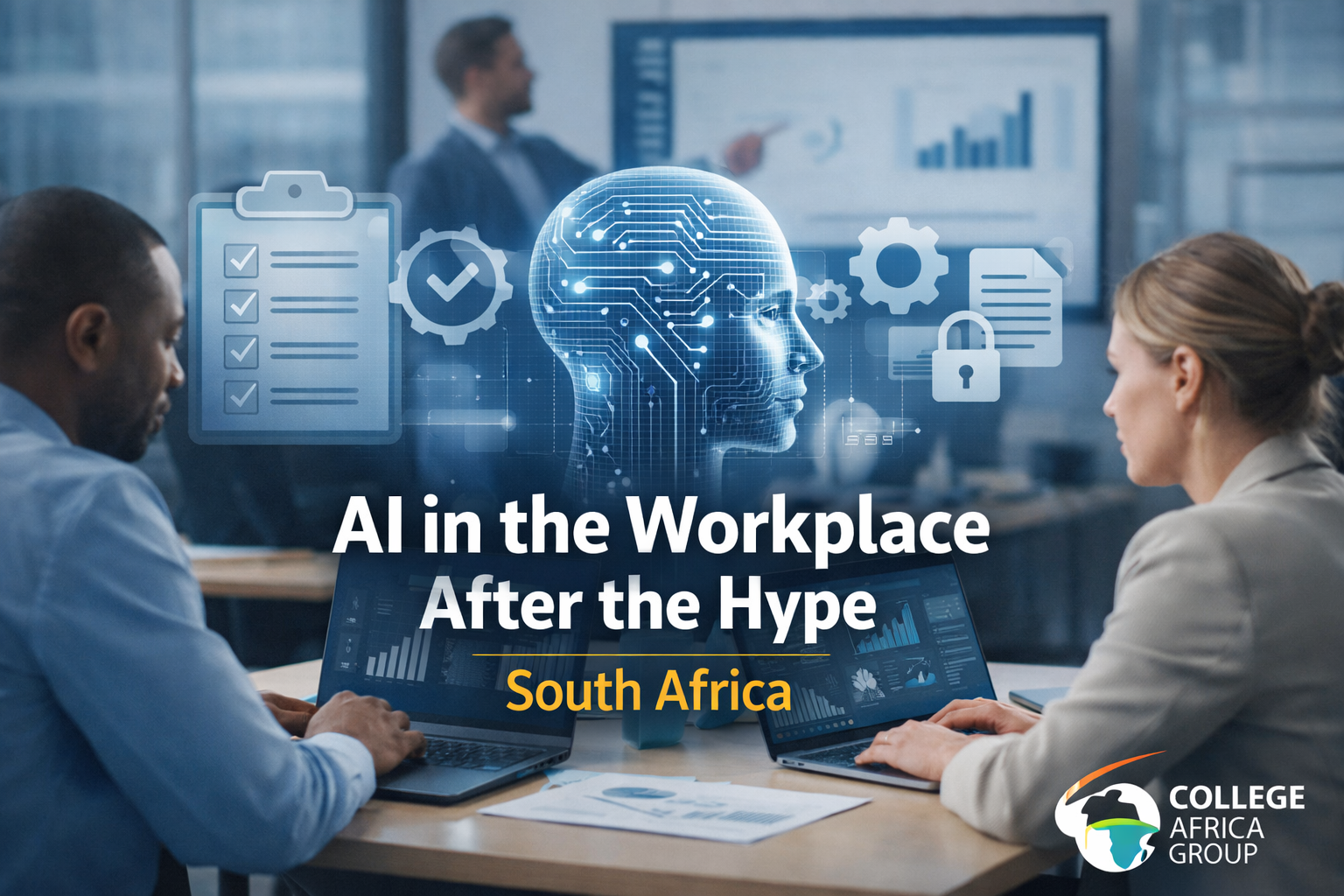
AI in the Workplace Is No Longer a Competitive Advantage
AI in the Workplace Is No Longer a Competitive Advantage
AI tools, prompt libraries, and automation promises have dominated AI in the workplace over the last two years.
At first, early adopters gained speed and visibility. Today, almost everyone has access to the same tools.
Global marketing leaders are now openly saying what many organisations are quietly experiencing:
The AI edge, like CHATGBT is gone.
For South African organisations, this moment is not a setback — it is a reset.
The question is no longer “Are we using AI?”
It is “Are we using AI properly, consistently, and safely?”
Why AI Stopped Being the Differentiator
AI tools have become commoditised. Chatbots, content generators, transcription tools, and copilots are widely available and increasingly similar.
When everyone has the same tools:
- Speed alone no longer creates advantage
- Prompts are easily copied
- Output quality converges
- Risk exposure increases
In South Africa, we see organisations reaching AI saturation without AI maturity.
Teams are experimenting, but leadership frameworks have not caught up.
The New Differentiator: Operating Model, Not Tools
High-performing organisations are separating themselves in three very specific ways:
1. Clear AI Usage Rules
They define where AI may be used, where it must not be used, and who is accountable.
This is especially critical in HR, finance, and customer communications.
2. Role-Based AI Workflows
Instead of generic prompt lists, AI is embedded into:
- Excel analysis and reporting
- HR documentation and policy drafts
- Admin and operations workflows
- Management decision support
The value comes from integration, not experimentation.
3. Governance and Compliance Awareness
South African organisations face unique regulatory realities.
POPIA compliance, data handling, and reputational risk now matter more than speed.
Why This Matters More in South Africa
Unlike Silicon Valley startups, most South African organisations:
- Operate with lean teams
- Have limited tolerance for risk
- Must justify productivity gains clearly
- Are accountable to boards, regulators, and clients
An uncontrolled AI rollout creates inconsistency, not efficiency.
The organisations winning right now are not the loudest adopters — they are the most disciplined ones.
AI After the Hype: What Leading Teams Are Doing Differently
We consistently see strong outcomes when organisations:
- Shift AI ownership from individuals to the organisation
- Align AI use with existing Excel, reporting, and admin systems
- Train managers and teams together, not in isolation
- Document approved AI use cases clearly
This approach turns AI into a workplace capability, not a novelty.
From Global Insight to Local Execution
Global experts are right to call out AI fatigue.
Where many stop, however, is implementation.
In the South African corporate environment, the next phase of AI adoption is about:
- Structure
- Governance
- Productivity measurement
- Responsible use
That is where real, sustainable advantage now sits.
Move Beyond AI Hype — Build Practical Capability
College Africa Group (CAG) works with South African organisations to move from informal AI experimentation to structured, governed workplace use.
Our practical training focuses on:
- AI in the Workplace (1-Day Practical Course)
- AI for HR, Admin & Managers
- AI-assisted Excel and reporting workflows
- POPIA-aware AI usage frameworks
AI in the Workplace FAQs
Why is AI in the workplace no longer a competitive advantage?
AI in the workplace is no longer a competitive advantage because most organisations now use similar tools. Real advantage comes from governance, workflow integration, and measurable productivity outcomes.
What is the biggest AI mistake South African organisations are making?
The biggest mistake is informal AI use without approved workflows, quality checks, or governance—especially in HR, finance, and customer communication.
What does AI governance mean in a practical workplace context?
AI governance means defining approved and prohibited use cases, data-handling rules, review steps, and accountability for AI-generated work.
How can AI in the workplace improve productivity without increasing risk?
AI in the workplace improves productivity when it is used in role-based workflows with templates, approval steps, and a human-in-the-loop review process.
Is AI in the workplace POPIA-compliant in South Africa?
AI in the workplace can be POPIA-appropriate if organisations avoid personal data exposure, use approved tools, and train staff on safe prompting and data handling.
Which departments benefit most from AI in the workplace training?
Finance, HR, admin, operations, and management teams benefit most from AI in the workplace training, particularly when paired with Excel and reporting workflows.
What should an AI in the workplace policy include?
An AI in the workplace policy should include approved tools, restricted information rules, review requirements, accountability, and role-based use cases.
What is the fastest way to move beyond AI hype inside an organisation?
The fastest way to move beyond AI hype is to run an AI readiness assessment, define approved AI use cases, train teams on workflows, and measure productivity improvements.
CAG Media Mentions & Further Reading on AI
AI adoption in the workplace is being actively discussed across leading global business, technology, and governance platforms. As organisations move beyond experimentation, the focus has shifted toward responsible use, governance frameworks, workforce impact, and measurable productivity outcomes.
For readers who would like to explore broader industry perspectives and research on AI in business and the future of work, the following sources provide additional context and insight.
AI adoption in the workplace is increasingly shaped by global research and industry guidance rather than tool-driven hype.
Ongoing insights from the World Economic Forum on artificial intelligence and the future of work,
analysis published by Harvard Business Review on AI in business strategy, and organisational research from
McKinsey & Company on AI adoption and governance.
These all point to the same conclusion: competitive advantage now comes from structured implementation, workforce capability, and governance.
Within the South African context, organisations must also consider the regulatory guidance issued by the
Information Regulator of South Africa under POPIA, particularly when AI tools intersect with personal or organisational data.
To discuss a practical, organisation-ready AI approach:
📞 +27 (0) 83 778 4903
🌐 Request a consultation
⚖️ This solution is designed to remain POPIA-appropriate when implemented correctly. It does not access, share, or store personal data. Organisations should still review their internal policies and compliance frameworks before adoption.

You may also like

Is Your Confidential Data Safe in Free AI Tools?
Business Process Improvement or Simply Buying AI?