
Generic AI training hasn’t changed how our finance, HR or management teams work. What will?
Training built around each team’s own documents, data and decisions. A finance manager, auditor, HR professional, engineer and managing director do not use AI in the same way. AI Training by Business Function and Role from College Africa Group applies ChatGPT, Microsoft Copilot, Excel and Microsoft 365 to the work each function actually does, so the training changes daily work rather than staying theoretical.
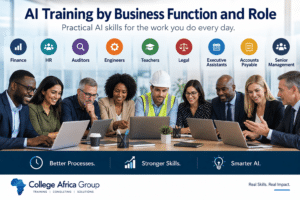
A Finance Manager, Auditor, Engineer, HR professional, Teacher, Executive Assistant and Managing Director do not use AI in the same way. Their responsibilities, information, risks, decisions and required outputs are different.
College Africa Group provides practical function-based and role-based AI training that applies ChatGPT, Microsoft Copilot, Excel and Microsoft 365 to the documents, data, decisions and workflows employees actually work with.
Employees learn where AI can save time, how to ask better questions, how to work with documents and data and, importantly, how to determine whether an AI-generated result can be trusted.
The objective is not simply to teach employees how to use AI. It is to help them use AI effectively in their particular business function or professional role.
Explore AI Training by Business Function and Role
Finance |
Accounts Payable |
Auditors |
HR |
Engineers |
Teachers & Educators |
Executive Assistants & Secretaries |
Legal |
Sales & Marketing |
Operations |
Executives
Why Should AI Training Be Relevant to the Employee’s Work?
Many organisations begin AI adoption with general awareness or prompting training. That provides an important foundation, but employees soon begin asking a more practical question:
“How can I use AI in my actual job?”
The answer changes from one business function and professional role to another.
A finance employee may need to reconcile transactions or investigate a variance. An auditor may need to identify exceptions. An engineer may need to compare technical information. HR may need to analyse workforce information. An Executive Assistant may need to turn a long report into an executive briefing.
This is why College Africa Group provides specialist AI Training by Business Function together with practical role-based AI training.
Our approach moves from general AI knowledge towards practical workplace application:
Workplace Problem → Source Information → AI Assistance → Required Output → Human Verification → Business Action
AI for Finance
Reconciliation • Financial analysis • Budget vs Actual • Reporting • Excel • Decision support
How can finance teams use AI for real financial work rather than simply asking ChatGPT or Copilot questions?
AI for Finance focuses on recurring finance activities including financial reconciliation, extracting information from PDFs and documents, Budget vs Actual analysis, management reporting and financial dashboards.
Delegates work with AI together with Excel so that financial information can be analysed more quickly while calculations and results can still be checked against the original source data.
Can AI reconcile two spreadsheets or identify transactions that do not match? AI can assist with identifying likely matches, split payments, credits and exceptions. Excel formulas and control totals can then be used to verify the reconciliation rather than simply accepting the AI-generated result.
Our advanced finance programme progresses into Debtors Age Analysis, cash-flow forecasting, scenario analysis, profitability and margin analysis, financial exceptions and CFO decision support.
Explore AI for Finance Advanced
AI for Accounts Payable
Invoices • Purchase orders • Supplier statements • Exceptions • Reconciliation • Payment information
Can AI help Accounts Payable teams process invoices and supplier information more efficiently?
Accounts Payable involves large amounts of repetitive document and transaction work. AI can assist employees with extracting invoice information, comparing documents, investigating exceptions and preparing supplier communication.
Practical applications can include invoice data extraction, purchase order and invoice comparisons, duplicate invoice investigation, supplier statement reconciliation, missing information, payment exceptions and supplier queries.
Can AI identify possible duplicate invoices or differences between an invoice and purchase order? AI can assist with identifying potential anomalies and differences, but those exceptions must still be verified against the organisation’s financial records and source documents before payment decisions are made.
AI for Auditors
Document review • Exception identification • Evidence comparison • Data analysis • Audit preparation
How can auditors use AI without compromising professional judgement?
Role-based AI training for auditors focuses on practical activities such as document review, data analysis, exception identification, summarisation, comparison of evidence and preparation of working information.
An auditor may, for example, use AI to investigate a large transaction dataset and identify unusual entries that require further examination.
Can AI identify anomalies or suspicious patterns in Excel data? AI can help surface unusual patterns, duplicates, exceptions and relationships. These findings should be treated as areas for investigation rather than automatic audit conclusions.
Verification, evidence, confidentiality and professional judgement remain fundamental. AI assists the audit process; it does not replace the auditor.
AI for HR and People Analytics
Recruitment • HR documents • Employee communication • People Analytics • Excel • Management reporting
How can HR teams use AI with workforce information?
AI can help HR professionals move beyond administrative use and start applying AI to recruitment, HR documents, employee communication, workforce analysis and management reporting.
Applications can include analysing employee data, summarising survey feedback, preparing reports, identifying workforce trends, developing training material and turning HR information into clearer management insights.
Can AI analyse employee data and help HR identify workforce trends? AI can assist with exploring data relating to headcount, absence, turnover, learning, skills and other workforce measures. HR professionals still need to understand the data, its limitations and the organisational context before drawing conclusions.
College Africa Group’s approach combines practical AI skills with Excel, data analysis, visualisation and management communication where appropriate.
Explore AI for HR Training South Africa
AI for Engineers
Technical documents • Specifications • Project information • Data • Research • Technical reporting
How can engineers use ChatGPT or Microsoft Copilot in their everyday work?
AI training for engineers can apply ChatGPT or Microsoft Copilot to technical documents, specifications, project information, calculations, reports and data.
AI can assist with summarising technical information, comparing specifications, extracting information from documents, organising project data, investigating datasets, drafting reports and improving technical communication.
Can AI compare technical documents and identify differences? AI can assist with identifying changes, inconsistencies and areas requiring attention, but technical conclusions must be checked against the original documents and the engineer’s professional knowledge.
The purpose is to accelerate information-intensive work without transferring engineering responsibility to the AI system.
AI for Teachers and Educators
Lesson planning • Assessments • Learning material • Research • Administration • Learner support
How can teachers use AI without simply asking it to write lessons for them?
AI training for teachers and educators can support lesson planning, assessment development, rubrics, examples, learning activities, research, administration and adapting material for different learner requirements.
Can AI help create assessments and teaching material? AI can assist with drafting questions, examples, activities and assessment structures. The educator remains responsible for checking accuracy, appropriateness, learning outcomes and the quality of the final material.
Role-based AI training for educators should therefore cover both AI productivity and the ability to critically evaluate AI-generated educational content.
AI for Personal Assistants, Executive Assistants and Secretaries
Email • Meetings • Executive briefings • Documents • Research • Presentations • Action tracking
How can a Personal Assistant, Executive Assistant or Secretary use AI at work?
Role-based AI training for Personal Assistants, Executive Assistants and Secretaries focuses on practical activities involving email, documents, meetings, actions, research and executive communication.
ChatGPT and Microsoft Copilot can assist with drafting and summarising emails, preparing agendas, organising meeting information, summarising documents, creating executive briefs, researching information, preparing presentations and tracking actions.
Can AI turn a long report into a short briefing for an executive? AI can assist with extracting key points, decisions, risks and actions from lengthy information. The assistant should verify the briefing against the original document before it is passed to the executive.
AI for Legal Professionals
Contract comparison • Document review • Clauses • Chronologies • Correspondence • Research support
How can legal professionals use AI safely in document-intensive work?
AI training for legal professionals focuses on practical uses of AI within document-intensive work while maintaining confidentiality, verification and professional responsibility.
AI can assist with document summarisation, contract comparison, extracting clauses and obligations, creating chronologies, identifying inconsistencies, organising information and preparing initial drafts of correspondence or reports.
Can AI compare two contracts and identify clauses that have changed? AI can assist with the comparison and highlight possible differences, but the legal professional must check the original documents and determine the legal significance of those differences.
Confidentiality, verification, source checking and professional responsibility are particularly important when AI is used for legal work.
AI for Sales and Marketing
Research • Customer meetings • Proposals • Sales analysis • Campaign planning • Communication
How can sales and marketing teams use AI for more than writing social media posts?
AI can support research, customer communication, proposal preparation, campaign planning, sales analysis, meeting preparation and marketing content.
Sales professionals can use AI to prepare for customer meetings, summarise account information, develop questions, analyse sales data and draft follow-up communication.
Can AI help a sales team prepare for a customer meeting? AI can organise available customer information, summarise previous communication, identify useful discussion areas and help prepare questions. Employees should verify factual information before relying on it during a customer interaction.
AI for Operations and Administration
Processes • Documents • Reports • Spreadsheets • Procedures • Workflow improvement
Where can AI save time in everyday administration and operational work?
Operations and administrative teams frequently deal with repetitive documents, reports, schedules, spreadsheets, procedures, emails and information requests.
AI can assist with summarising information, comparing documents, drafting procedures, analysing operational data, preparing reports and identifying repetitive processes that may be suitable for improvement.
Can AI help identify inefficient workplace processes? When a workflow is mapped clearly, AI can help identify repeated data capture, unnecessary hand-offs, duplicated work and information bottlenecks. The organisation can then determine which improvements should be implemented.
AI for Executives and Senior Management
Research • Decision support • Reports • Scenario analysis • Executive communication • AI strategy
How should Managing Directors, executives and senior managers use AI?
Role-based AI training for executives and senior management focuses on research, decision support, analysis, communication and identifying where AI can improve organisational productivity.
Practical applications include executive research, interrogating reports, summarising complex information, scenario analysis, preparing board or management communication and challenging assumptions before decisions are made.
Can AI help executives make better-informed decisions? AI can help management investigate information, compare scenarios and surface questions that may otherwise be missed. It should support executive judgement rather than make the decision on management’s behalf.
Executive and senior management AI training should also help leaders identify where AI can realistically improve workflows across Finance, HR, Sales, Operations and other business functions.
What Is the Difference Between Function-Based and Role-Based AI Training?
Function-based AI training focuses on work performed within a particular business area, such as Finance, HR, Accounts Payable, Sales or Operations.
Role-based AI training focuses more specifically on the responsibilities of particular professionals, such as Auditors, Engineers, Teachers, Executive Assistants, Legal Professionals or senior executives.
Both approaches have the same objective: to move AI training closer to the employee’s actual work.
Instead of asking every employee to complete identical generic exercises, delegates work with problems, information and outputs relevant to their business function or professional role.
Should Employees Learn ChatGPT or Microsoft Copilot?
The appropriate platform depends partly on the technology already available within the organisation and the work employees need to perform.
College Africa Group works with both ChatGPT and Microsoft Copilot. Where appropriate, specialist programmes can be delivered using the platform already adopted by the organisation.
The business problem remains the starting point. The AI platform is the tool used to help solve it.
Should Every Department Receive the Same AI Training?
Not necessarily.
Employees across an organisation should understand common principles such as prompting, verification, confidentiality and responsible AI use. However, practical application becomes more valuable when exercises reflect what employees actually do.
A generic AI course may teach an Accountant and an Engineer the same prompting technique. Function-based and role-based AI training then teaches them how to apply that technique to completely different workplace problems.
This creates a logical development pathway:
AI Awareness → Practical AI Skills → Function or Role-Specific Application → Workflow Improvement
From AI Training to Workplace Implementation
What happens after employees learn how to use AI?
The next opportunity is to identify where AI can improve actual organisational processes.
College Africa Group’s AI Workflow Discovery approach examines real workplace activities to identify repetitive work, information bottlenecks, document-heavy processes and opportunities where AI may improve productivity.
This moves the conversation from:
“What can AI do?”
to:
“Where can AI save our employees time?”
Corporate AI Training for Different Business Functions and Roles
College Africa Group has provided corporate training since 2003 and delivers instructor-led programmes across South Africa and Southern Africa.
AI Training by Business Function can be delivered onsite, live virtually or as part of a broader organisational AI development programme.
Programmes can focus on a particular business function, professional role or group of employees who perform similar workplace activities.
If your organisation has a department or professional group that is not listed above, we can discuss the work employees perform and determine whether a specialist function-based or role-based AI programme is appropriate.
Not Sure Which AI Training Your Teams Need?
Different departments often need different levels of AI capability. A Finance team, HR department, Engineering team and senior management group may use the same AI platform but apply it to very different workplace problems.
College Africa Group can help identify the activities employees perform, where AI may save time, which platform is appropriate and where specialist function-based or role-based training would add the most value.
Department → Workflows → AI Opportunities → Skills Required → Training
This can also lead into AI Workflow Discovery, where the focus moves beyond learning how to use AI and into identifying repetitive work, information bottlenecks and practical opportunities to improve workplace processes.
Ready to Make AI Relevant to the Work Your Employees Actually Do?
Talk to College Africa Group about AI Training by Business Function for your Finance, HR, Accounts Payable, Audit, Engineering, Sales, Administration, Legal or management teams.
We can help you identify the most appropriate function-based or role-based programme for your employees, using ChatGPT or Microsoft Copilot according to the tools available in your organisation.
Discuss Your AI Training Requirements
WhatsApp 083 778 4903
|
Call 083 778 4903
|
Email College Africa Group
Better Processes. Stronger Skills. Smarter AI.
Frequently Asked Questions About AI Training by Business Function and Role
What is AI Training by Business Function?
AI Training by Business Function teaches employees how to apply AI to the actual work performed within their department or professional role. Instead of relying only on generic AI examples, training focuses on practical activities relevant to Finance, HR, Auditing, Engineering, Education, Legal, Administration, Sales, Operations and senior management.
Why is role-based AI training different from general AI training?
General AI training provides important foundations such as prompting, verification and responsible use. Function-based and role-based training takes the next step by connecting those skills to the employee’s actual responsibilities, information, documents, data and required workplace outputs.
Should every employee receive the same AI training?
Not necessarily. Employees benefit from common AI foundations, but a Finance Manager, Auditor, Engineer, HR professional and Executive Assistant perform very different work. Specialist training allows employees to practise AI using activities that are more relevant to what they actually do.
What are practical uses of AI in Finance?
Finance teams can use AI to assist with reconciliation, extracting financial information from documents and PDFs, Budget vs Actual analysis, management reporting, dashboards, Debtors Age Analysis, cash-flow scenarios, profitability analysis and decision support. AI-generated results should still be verified against the original financial information.
How can Accounts Payable teams use AI?
Accounts Payable teams can use AI to assist with invoice data extraction, supplier statement reconciliation, comparing purchase orders and invoices, investigating possible duplicate invoices, identifying missing information and preparing supplier queries.
How can auditors use AI?
Auditors can use AI to assist with document review, data analysis, exception identification, evidence comparison and summarisation. AI can help identify transactions or information requiring further investigation, but professional judgement, evidence and verification remain the responsibility of the auditor.
How can HR teams use ChatGPT or Microsoft Copilot?
HR teams can use ChatGPT or Microsoft Copilot to assist with recruitment, HR documents, employee communication, workforce analysis, reporting, learning material and other information-intensive HR activities. Appropriate confidentiality, data protection and human oversight remain important.
How can engineers use AI in their work?
Engineers can use AI to assist with technical document review, specification comparisons, project information, data investigation, research, reporting and technical communication. AI can accelerate information-intensive work, while technical conclusions remain the responsibility of the engineer.
How can Personal Assistants and Executive Assistants use AI?
Personal Assistants, Executive Assistants and Secretaries can use AI for email drafting, meeting preparation, agendas, document summaries, executive briefings, research, presentations and action tracking. Role-based training helps them apply AI to everyday activities while maintaining accuracy and confidentiality.
How can executives and senior managers use AI?
Executives and senior managers can use AI for research, briefing, report analysis, scenario investigation, management communication and decision support. Training can also help leaders understand how different departments may use AI and where workflow improvements could create business value.
Should employees use ChatGPT or Microsoft Copilot?
The appropriate platform depends on the organisation’s technology environment and the work employees need to perform. College Africa Group can deliver practical training using ChatGPT or Microsoft Copilot, with exercises adapted to the relevant business function or professional role.
How do companies move from AI training to practical implementation?
After employees understand how to use AI, organisations can examine real workflows to identify repetitive work, document-heavy processes, information bottlenecks and opportunities for improvement. This can progress from individual skills development into practical workplace application and AI Workflow Discovery.