
AI and Data Analytics Course Using Excel Copilot and ChatGPT
Turn Business Data into Better Business Decisions
Every generation of technology has changed the way organisations work. Artificial Intelligence is now changing the way organisations analyse data, prepare reports and make business decisions. However, AI does not replace critical thinking or business judgement. The greatest value comes from combining AI with trusted business tools such as Microsoft Excel and validating AI-generated insights before decisions are made.
The AI and Data Analytics Course Using Excel, Copilot and ChatGPT from College Africa Group helps business professionals analyse data more effectively, improve reporting accuracy, validate AI-generated outputs and make better business decisions using Microsoft Excel, Microsoft Copilot and ChatGPT.
Designed for finance professionals, managers, HR teams, administrators and business analysts, this practical course focuses on improving productivity, strengthening data analysis skills and ensuring AI supports informed decision-making rather than replacing human judgement.
Enquire About This Course
View Advanced Excel Training
Not Sure Which Excel level your staff should start with?
Use College Africa Group’s Excel Skills Assessment to help determine whether an employee has the Excel foundations required for more advanced training.
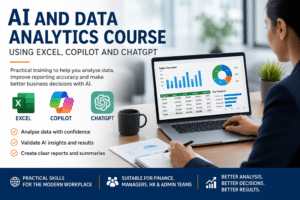 AI and Data Analytics Course for Business Professionals
This business-focused training teaches practical data analysis, Excel reporting, AI prompting, Microsoft Copilot usage and ChatGPT-assisted reporting for everyday workplace tasks. It is not a coding, Python or machine learning course.
The course is ideal for professionals who need to understand data, explain trends, prepare reports and make better decisions without becoming data scientists.
Benefits of Practical AI Data Analysis Training
AI can help employees work faster, but the real benefit is better accuracy and stronger judgment. AI can summarise information and suggest insights, but people still need to verify the results.
Delegates learn how to combine Excel skills, AI prompts and business thinking so that reports are not only faster to prepare, but also more reliable.
An AI and Data Analytics Course helps organisations improve the way they analyse information, prepare reports and validate business insights. Rather than relying solely on AI-generated outputs, delegates learn how to combine Excel skills, critical thinking and structured analysis techniques to produce more reliable results.
This AI and Data Analytics Course is particularly valuable for organisations that are introducing Microsoft Copilot or ChatGPT into the workplace. Employees learn how to use these tools productively while maintaining accountability, reporting accuracy and professional judgement.
An AI and Data Analytics Course helps organisations improve reporting quality, analyse trends faster and validate AI-generated insights before they are used in business decisions. This practical approach combines technology with professional judgement.
Unlike technical data science programmes, this AI and Data Analytics Course focuses on workplace applications using Excel, Microsoft Copilot and ChatGPT. Delegates learn skills that can be applied immediately in finance, administration, HR and management environments.
AI generates language — not the truth.
AI suggests — humans verify.
AI supports productivity — humans remain responsible.
What Is Included in This AI and Data Analytics Course
| Module | Workplace Application |
|---|---|
| Excel Data Foundations | Prepare, clean and structure data for analysis. |
| ChatGPT for Data Analysis | Use prompts to explain trends, draft insights and question data. |
| Microsoft Copilot for Excel | Use Copilot to explore spreadsheet data and support reporting. |
| AI Data Validation | Check AI outputs against source data, formulas and business logic. |
| AI Reporting Skills | Convert analysis into clear management summaries and reports. |
| Responsible AI Use | Apply POPIA awareness, confidentiality and human review. |
Unlike many generic AI programmes, this AI and Data Analytics Course focuses on practical business applications. Delegates work with real workplace scenarios involving Excel reports, management information, dashboards and operational data rather than theoretical data science concepts.
College Africa Group has extensive experience delivering Excel, reporting and analytics training. This AI and Data Analytics Course builds on those foundations by showing delegates how to use AI tools alongside proven data analysis techniques.
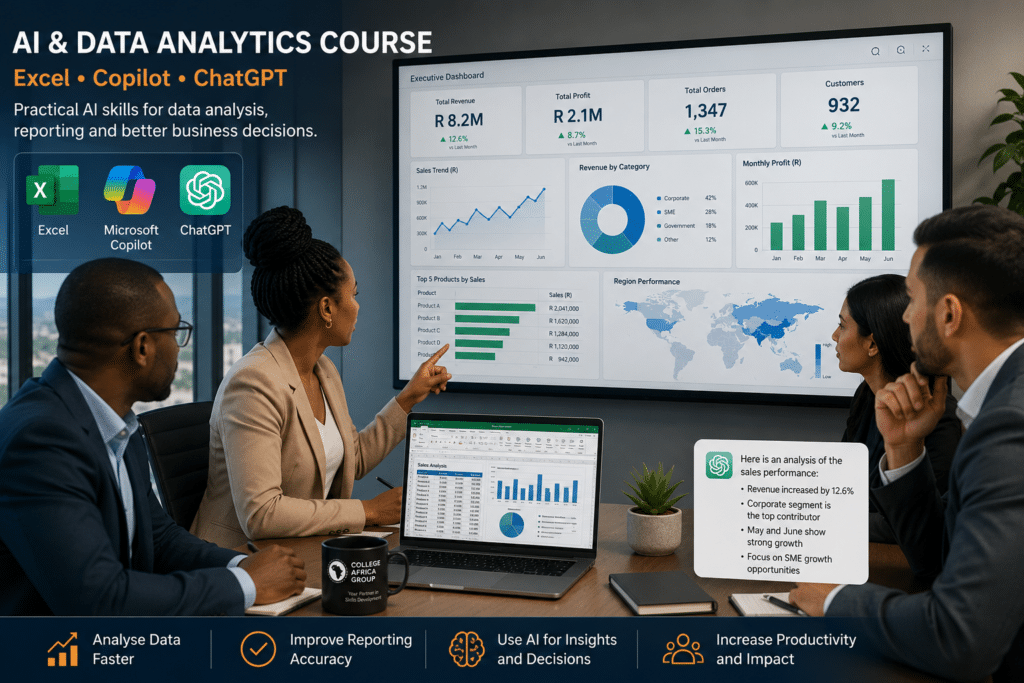 Using Excel for AI-Assisted Data Analysis
Excel remains one of the most important tools for business data analysis. Delegates learn how to use Excel together with AI tools while still understanding formulas, tables, filters, charts, PivotTables and data structure.
Someone who cannot identify an incorrect Excel formula may also struggle to identify an incorrect AI-generated answer. This is why strong Excel skills remain important in the AI era.
Download the AI and Data Analytics Course Outline
Learn how organisations are using Excel, Microsoft Copilot and ChatGPT to improve reporting, data analysis and business decision-making while maintaining reporting accuracy, data validation and human accountability.
The course outline includes: Who should attend this programme
- Learning outcomes and business benefits
- Complete 8-module course structure
- Practical ChatGPT and Copilot applications
- Excel skills required for successful AI adoption
- AI reporting accuracy and data validation frameworks
- Dashboard analysis and business insight techniques
- Responsible AI, governance and POPIA considerations
Download your complimentary course outline below.
Using Microsoft Copilot for Data Analytics
Microsoft Copilot can help users explore spreadsheet data, generate summaries, suggest trends and support business reporting. However, Copilot works best when data is clean, structured and properly prepared.
The course teaches delegates how to use Copilot as a productivity assistant while still checking outputs before they are used in reports or decisions.
Using ChatGPT for Data Analytics
ChatGPT can assist with explaining data, drafting report commentary, generating questions and improving business communication. Delegates learn how to write better prompts and review AI-generated responses carefully.
The aim is not to let ChatGPT replace analysis. The aim is to use ChatGPT to support thinking, improve clarity and speed up routine reporting work.
AI Data Analytics for Finance Teams
Finance teams can use AI to support variance commentary, management reports, budget explanations, dashboard summaries and monthly reporting. However, financial information must always be checked against the source data.
This training is useful for accountants, finance managers, bookkeepers, analysts and reporting teams who want to improve productivity without reducing accuracy.
AI Data Analytics for HR and Administrative Teams
HR and administrative teams often work with employee records, registers, reports, meeting notes and operational data. AI can help summarise and organise information, but confidential information must be handled carefully.
The training helps HR and admin teams use AI safely, practically and responsibly while maintaining human review and approval.
Why Human Validation Still Matters
AI can make work faster, but faster is not always better if the results are wrong. AI-generated reports can sound confident while still containing incorrect assumptions, missing context or inaccurate calculations.
Delegates learn to compare AI outputs against Excel formulas, source data, business rules and common sense. AI can suggest. Excel can calculate. People must verify.
Who Should Attend This AI and Data Analytics Course
- Finance and accounting teams are producing reports and analysis
- Managers who rely on Excel reports for decision-making
- HR professionals working with employee data and reports
- Administrative professionals responsible for spreadsheets and summaries
- Excel users who want to use ChatGPT and Copilot more effectively
- Teams that need better AI data validation and reporting accuracy
Course Outcomes
By the end of this training, delegates will be able to:
- Use Excel, Copilot and ChatGPT to support business data analysis
- Ask better questions when working with spreadsheets and reports
- Identify possible errors in AI-generated summaries
- Validate results using Excel logic, formulas and source data
- Create clearer management reports and business summaries
- Understand when AI is helpful and when human judgment is required
By completing this AI and Data Analytics Course, delegates gain a better understanding of how AI can support workplace productivity without replacing human oversight.
The course emphasises validation, decision-making and responsible use of business data.
AI and Data Analytics Course South Africa
College Africa Group offers this AI and Data Analytics Course across South Africa, including Johannesburg, Cape Town, Durban, Pretoria and virtual delivery for national teams.
The course can be delivered as a standalone workshop or combined with Advanced Excel, Excel Dashboards, Power Pivot, Microsoft Copilot Training or ChatGPT for Business training.
As AI adoption grows, demand for practical AI and Data Analytics Course training continues to increase. Organisations need employees who can understand data, question AI outputs and communicate findings accurately to stakeholders.
Related Training Courses
- AI in the Workplace Training
- ChatGPT for Business Course South Africa
- Microsoft Copilot Training South Africa
- Advanced Excel Executive Training
- Excel Dashboard Training
For external reference, delegates may also review official resources from Microsoft Copilot and ChatGPT.
Enquire About Our AI and Data Analytics Course
Equip your team to use Excel, Copilot and ChatGPT more productively while improving reporting accuracy, AI data validation and responsible AI use.
College Africa Group
Phone: +27 (0) 83 778 4903
Email: sales@collegeafricagroup.com
Frequently Asked Questions
What is included in this course?
This course includes Excel data foundations, ChatGPT prompts, Microsoft Copilot examples, AI data validation, reporting skills and responsible AI use.
Is this training technical?
No. This is business-focused training. It is not a Python, coding or machine learning course. It focuses on practical workplace data analysis and reporting.
Does the course include Excel?
Yes. Excel is a core part of the course because many South African businesses still rely on Excel for reporting, dashboards and management information.
Does the course include Microsoft Copilot?
Yes. The course can include Microsoft Copilot examples for Excel, Word, PowerPoint, and workplace reporting, with access to Copilot.
Can ChatGPT analyse Excel data?
ChatGPT can assist with interpreting, summarising and explaining data, but results must always be verified against the original spreadsheet and business context.
Is this suitable for finance teams?
Yes. Finance teams benefit significantly because the course focuses on reporting accuracy, validation, Excel analysis, and the responsible use of AI-generated insights.
Does this training include POPIA awareness?
Yes. The course includes practical guidance on safe prompting, confidential information, workplace data and responsible AI use in a South African business context.
Can the training be delivered onsite?
Yes. College Africa Group offers onsite, virtual and customised corporate AI and data analytics training for teams across South Africa.
Microsoft Learn
ChatGPT
⚖️ This solution is designed to remain POPIA-appropriate when implemented correctly. It does not access, share, or store personal data. Organisations should still review their internal policies and compliance frameworks before adoption.