
AI for Finance Core
Help Your Finance Team Use AI for Real Financial Work
AI for Finance Core is a practical, instructor-led programme for finance professionals who want to move beyond general AI prompting and apply ChatGPT or Microsoft Copilot to genuine financial work.
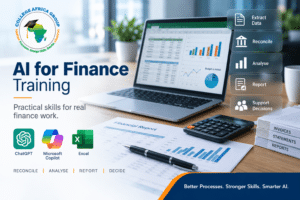
Delegates learn how to combine AI with Excel to accelerate financial reconciliation, document processing, Budget vs Actual analysis, management reporting and financial dashboards — while keeping financial verification and human judgement in the process.
The programme focuses on recurring finance activities employees deal with every month. Delegates work with practical financial information, compare transactions, identify exceptions, extract data from documents and turn verified financial analysis into useful management information.
AI proposes. Excel checks. Finance approves.
This is not an introductory AI course. Delegates should already have a working knowledge of ChatGPT or Microsoft Copilot and be comfortable working with normal Excel data and formulas.
Download the AI for Finance Core Course Outline
Choose Your AI for Finance Core Programme
AI for Finance Core is available in two versions, depending on the AI platform your organisation uses.
Microsoft Copilot for Finance
For organisations using Microsoft Copilot and Microsoft 365. Delegates complete the practical finance exercises using Microsoft Copilot with Excel and other Microsoft 365 applications.
ChatGPT for Finance
For organisations using ChatGPT. Delegates complete the same finance exercises and business scenarios using ChatGPT with Excel, with the workflow and prompts adapted specifically for ChatGPT.
The finance outcomes are the same. The difference is the AI platform used to complete the work. Your organisation can select the version that matches the tools already available to your finance team.
Common Finance Problems This Training Addresses
Finance teams often spend substantial amounts of time preparing, checking, reconciling, analysing and explaining financial information. AI for Finance Core focuses on practical problems where AI can assist without removing financial controls or professional judgement.
Reconciliations Take Too Long
AI can assist with investigating possible transaction matches, split payments, credits and exceptions. Excel controls and the original financial records are then used to verify the proposed reconciliation.
Financial Information Arrives Trapped in PDFs and Documents
AI can assist with extracting information from supplier statements, customer statements, invoices and other financial documents and structuring it for further analysis in Excel.
Budget vs Actual Reporting Shows What Changed but Not What Matters
AI can accelerate variance investigation by helping finance employees identify significant movements, exceptions and questions requiring further investigation.
Management Reporting Takes Too Much Preparation Time
AI can help turn verified financial analysis into clearer management commentary, executive summaries and reports without requiring finance employees to draft every explanation from the beginning.
Finance Teams Are Using AI but Do Not Always Trust the Output
The programme builds verification into the workflow. Source data, Excel formulas, financial controls and professional judgement are used to determine whether AI-generated results can be relied upon.
Practical AI for Finance Core
Finance requires more than simply generating an answer. Financial information must be accurate, explainable and capable of being checked.
This programme teaches delegates how to combine AI with existing financial knowledge, Excel and appropriate controls.
The practical workflow used throughout the programme is:
Source Data → Process → Required Output → AI Assistance → Financial Verification
Where the information starts outside Excel, the workflow becomes:
PDF / Document / Email → Extract → Structure → Excel → Analyse → Verify → Explain → Management Action
The emphasis is on completing realistic finance tasks rather than learning AI features in isolation.
AI for Finance Core: Financial Reconciliation
Can AI reconcile two separate Excel spreadsheets?
Financial reconciliation often requires finance employees to compare transactions from different sources and determine which items belong together.
Delegates work with two independent financial datasets, such as a customer or supplier statement and financial records exported from an accounting system such as Sage.
The practical exercise includes:
- exact transaction matches;
- different transaction descriptions;
- transactions posted on different dates;
- partial payments;
- combined payments;
- credits and adjustments;
- one-to-many and many-to-one matches; and
- transactions that remain unreconciled.
AI is used to assist with identifying possible relationships between transactions. Excel controls are then used to confirm whether proposed reconciliations balance correctly and to identify items that remain outstanding.
AI proposes. Excel checks. Finance approves.
This demonstrates where AI can be particularly useful: identifying patterns and possible matches that may take a person considerably longer to investigate manually.
Financial Documents and PDF Data to Excel
Can AI extract financial information from a PDF and put it into Excel?
Not all financial information arrives in a clean spreadsheet.
Finance teams regularly receive supplier statements, customer statements, invoices, quotations and other financial documents as PDFs, attachments or copied information.
Delegates work with unstructured financial information and use AI to extract and organise relevant data.
This is an important AI for Finance workflow because much of the information handled by finance teams originates outside a structured Excel workbook.
The exercise includes:
- extracting financial information from PDF documents;
- identifying invoice and reference numbers;
- capturing transaction dates;
- extracting supplier or customer information;
- identifying VAT and financial values;
- standardising inconsistent descriptions;
- identifying missing or incomplete information; and
- structuring the information into rows and columns suitable for Excel.
The extracted information is then checked against the original source document.
Faster data capture has little value if incorrect financial information is transferred into the accounting or reporting process.
Budget vs Actual Analysis and Financial Exceptions
Can AI identify the financial variances that actually require attention?
Budget vs Actual reporting is a common finance activity, but producing the numbers is only part of the job. Finance also needs to identify what changed, determine what deserves attention and explain the result to management.
Delegates work with financial data containing budgets, actual results and business information requiring investigation.
The exercise includes:
- analysing Budget vs Actual results;
- identifying significant financial variances;
- finding unusual movements and exceptions;
- reviewing changes in revenue and expenditure;
- investigating changes in margins;
- separating material issues from normal fluctuations;
- developing questions for further investigation; and
- preparing initial management commentary.
The objective is to move beyond simply reporting a variance.
Financial Data → Variance → Investigation → Explanation → Management Action
AI helps accelerate the analysis and identify areas requiring attention. The finance professional determines whether the interpretation makes financial and commercial sense.
Management Reporting with AI
How can AI help finance teams prepare monthly management reports faster?
Finance professionals are regularly required to turn detailed financial information into concise reports for managers who may not need or want to see every transaction or calculation.
Delegates use completed financial analysis to develop clearer management reporting.
Practical activities include:
- summarising key financial findings;
- explaining material variances;
- highlighting financial risks and exceptions;
- identifying matters requiring management attention;
- drafting financial commentary;
- developing questions for management;
- creating concise executive summaries; and
- improving recurring finance reports.
AI is used to accelerate the first draft and organise the information. Delegates then check that the commentary is supported by the underlying financial data.
Financial Dashboards and Visual Reporting
Financial information becomes more useful when managers can quickly see the measures, trends and exceptions that require attention.
Delegates use completed financial information to create a simple management view.
Activities include:
- identifying appropriate financial KPIs;
- calculating headline measures;
- displaying reconciled and unreconciled transactions;
- highlighting outstanding financial values;
- using conditional formatting to identify exceptions;
- creating appropriate charts; and
- turning detailed financial information into a concise visual report.
The objective is not to create decorative dashboards. The purpose is to make financial information easier to understand, investigate and act upon.
Using ChatGPT, Microsoft Copilot and Excel for Finance
Which AI tool should a finance team use?
The programme is not built around one AI product.
Depending on the organisation’s available tools and licences, delegates may work with ChatGPT, Microsoft Copilot and Excel.
Different tools are useful for different parts of a finance workflow. AI may assist with extracting information, recognising patterns, analysing results, explaining exceptions or drafting financial commentary. Excel remains particularly important for calculations, structured financial data and control totals.
Delegates therefore learn to choose an appropriate tool for the task rather than attempting to use AI for every stage of the process.
The financial problem remains the starting point. The AI platform is the tool used to help solve it.
Financial Verification and Human Judgement
How do you know whether an AI-generated financial result is correct?
AI-generated financial output can look convincing even when an assumption, transaction match or interpretation is incorrect.
Verification is therefore built into the practical exercises.
Delegates check:
- source transactions;
- financial totals;
- Excel formulas;
- reconciliation balances;
- unmatched transactions;
- information extracted from financial documents;
- unusual results and exceptions;
- assumptions used during analysis; and
- whether management commentary agrees with the underlying numbers.
AI generates an output. Finance determines whether that output is reliable.
Who Should Attend AI for Finance Core?
This course is designed for professionals who work with financial data, documents, analysis and reporting.
Suitable participants include:
- Finance Managers;
- Financial Managers and Financial Controllers;
- Management Accountants;
- Accountants and Assistant Accountants;
- Finance Officers;
- Bookkeepers;
- Debtors and Creditors personnel;
- Finance Analysts;
- Reporting professionals; and
- Managers responsible for financial information.
The programme is particularly relevant to finance teams that have already started using ChatGPT or Microsoft Copilot and now want to apply these tools more systematically to finance work.
AI for Finance Core Prerequisites
This is not a beginner AI course.
Delegates should already have a working knowledge of ChatGPT or Microsoft Copilot and understand basic prompting.
Participants should also be comfortable working with normal Excel data and formulas.
The programme does not spend significant time introducing artificial intelligence, teaching basic prompting or covering introductory Excel skills. The focus is on applying existing AI and Excel knowledge to practical finance activities.
AI for Finance Core Learning Outcomes
By the end of the programme, delegates should be able to:
- use AI to assist with financial reconciliation;
- compare independent financial datasets;
- identify possible transaction matches and exceptions;
- extract financial information from PDFs and documents;
- structure extracted financial information for Excel;
- analyse Budget vs Actual results;
- identify significant financial variances and exceptions;
- use AI to support management commentary;
- create clearer financial summaries and reports;
- develop simple financial dashboards and visual reporting;
- use Excel controls to validate AI-assisted work; and
- apply professional financial judgement before accepting AI-generated outputs.
Practical Training Methodology
The programme uses guided practical exercises rather than relying on demonstrations alone.
Delegates work through realistic financial scenarios using structured training data, spreadsheets and financial documents.
See it → Understand it → Practise it → Apply it → Check it
The standard programme uses generic cross-industry finance examples so that delegates can concentrate on the techniques without exposing confidential company information.
Organisation-specific financial spreadsheets, reports and internal processes can be addressed separately through a customised workshop or AI Workflow Discovery engagement.
AI for Finance Core Delivery
College Africa Group provides instructor-led corporate AI for Finance training in South Africa.
Training can be delivered:
- onsite at the client’s premises;
- live virtually;
- at a suitable offsite venue; or
- as part of a broader Excel, Microsoft 365 or workplace AI development programme.
The standard AI for Finance Core programme is structured as a practical one-day course.
Progress from AI for Finance Core to AI for Finance Advanced
AI for Finance Core establishes the practical foundation for using AI in recurring financial work.
The next programme, AI for Finance Advanced, moves into more complex finance applications including Debtors Age Analysis, cash-flow forecasting, scenario modelling, profitability and margin analysis, financial exceptions, CFO decision support, supplier quotation comparison and management communication.
Together, the two programmes provide a clear progression from everyday finance productivity into forecasting, financial judgement and decision support.
AI for Finance Core → AI for Finance Advanced → AI Workflow Discovery
Why College Africa Group?
College Africa Group has provided corporate training in South Africa since 2003.
Our experience across Microsoft Excel, Microsoft 365, ChatGPT, Microsoft Copilot and workplace AI allows the programme to combine AI capability with the practical tools finance employees already use.
The training focuses on practical workplace application, financial verification and skills that delegates can take back into their normal working environment.
College Africa Group is a BEE Level 2 company and provides instructor-led corporate training across South Africa.
As genuine finance-specific results and case studies become available, these can be incorporated into the programme evidence without relying on unverified productivity claims.
Related AI and Finance Training
- AI Training by Business Function and Role
- AI for Finance Advanced
- Microsoft Copilot Training South Africa
- ChatGPT for Business Course South Africa
- AI and Data Analytics Course
- Advanced Excel Training
- Advanced Modern Excel 365 Training
Frequently Asked Questions About AI for Finance Core
What is AI for Finance Core?
AI for Finance Core is a practical programme that teaches finance professionals how to apply ChatGPT or Microsoft Copilot together with Excel to recurring financial work including reconciliation, financial document extraction, Budget vs Actual analysis, management reporting, dashboards and financial verification.
Can AI reconcile two separate Excel spreadsheets?
AI can assist with comparing two separate financial datasets and identifying transactions that may belong together. This is particularly useful where transaction descriptions, dates or payment structures do not match exactly. Proposed matches should still be verified against the source data and appropriate Excel financial controls.
Can Copilot match a customer or supplier statement against data exported from Sage?
Financial data exported from Sage or another accounting system can be compared with a customer or supplier statement. AI can assist with identifying likely matches, missing transactions and exceptions, while Excel formulas and control totals are used to confirm whether the reconciliation is correct.
Can AI identify split payments, credits and transactions that don’t match exactly?
AI can help identify relationships that are difficult to find using exact matching alone. This can include partial payments, combined payments, credits, different transaction dates and descriptions that vary between the accounting records and the external statement. Finance professionals should verify every proposed match before accepting the reconciliation.
Can AI extract financial data from a PDF and put it into Excel?
AI can extract structured financial information from suitable PDFs and documents and organise it into rows and columns for Excel. This can include transaction dates, invoice numbers, suppliers, customers, descriptions, VAT amounts and financial values. The extracted information should be checked against the original document before it is used.
Can AI capture invoice information automatically instead of entering it manually?
AI can assist with extracting information such as supplier details, invoice numbers, dates, purchase order references, VAT and invoice totals. This can reduce repetitive manual data capture, but finance employees remain responsible for checking that the extracted information agrees with the original invoice.
Can AI analyse Budget vs Actual results and identify unusual financial variances?
AI can assist with analysing Budget vs Actual results, highlighting significant variances, unusual movements and financial exceptions that may require investigation. The finance professional then verifies the calculations, investigates the underlying cause and determines whether the variance requires management attention.
How can AI help finance teams prepare monthly management reports faster?
AI can help finance teams turn verified financial analysis into concise management commentary, summaries, exception reports and management questions. It can accelerate the reporting process by organising the important findings, but the final report should be checked against the underlying financial data before it is distributed.
How do you verify AI-generated financial commentary before sending it to management?
AI-generated financial commentary should be checked against the original financial data, calculations, variances, source documents and known business circumstances. Finance professionals should confirm that every material statement is supported by the numbers and that AI has not confused assumptions or possible explanations with established financial facts.
What is the difference between AI for Finance Core and AI for Finance Advanced?
AI for Finance Core concentrates on recurring finance activities including reconciliation, financial document extraction, Budget vs Actual analysis, management reporting and verification. AI for Finance Advanced progresses into Debtors Age Analysis, cash-flow forecasting, scenario modelling, profitability, financial decision support and more complex commercial comparisons.
Do delegates need Microsoft Copilot?
No. The finance methodology can be applied using suitable AI tools including ChatGPT and Microsoft Copilot. Practical delivery can be aligned with the tools and licences available within the organisation.
Can we use our own financial spreadsheets during the course?
The standard programme uses generic structured finance examples. Organisation-specific spreadsheets, reports and internal workflows are better addressed through a separate customised workshop or AI Workflow Discovery engagement.
Is AI for Finance Core available onsite?
Yes. College Africa Group provides instructor-led onsite and live virtual corporate AI for Finance training for organisations across South Africa.
Discuss AI for Finance Core for Your Finance Team
Move beyond general AI prompting and start applying ChatGPT, Microsoft Copilot and Excel to practical financial work.
College Africa Group can help your finance team develop practical AI capability while retaining Excel controls, financial verification and professional judgement.
Discuss Your Finance Team’s AI Training Requirements
WhatsApp 083 778 4903
|
Call 083 778 4903
|
Email College Africa Group
Better Processes. Stronger Skills. Smarter AI.