
AI for Finance Advanced
Use AI for Deeper Financial Analysis, Forecasting and Decision Support
AI for Finance Advanced helps finance professionals move beyond everyday AI assistance and use ChatGPT or Microsoft Copilot with Excel to investigate cash flow, debtor risk, profitability, financial scenarios and commercial decisions.
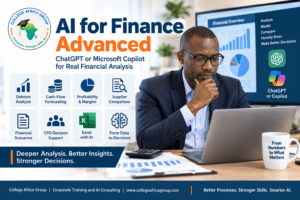
The programme works with realistic finance activities including Debtors Age Analysis, cash-flow forecasting, scenario analysis, profitability, margins, financial exceptions, CFO decision support and supplier quotation comparisons.
Delegates use AI together with Excel to investigate financial information, identify risks, test assumptions, verify results and turn financial analysis into useful management decisions.
AI accelerates the analysis. Excel verifies the numbers. Finance applies the judgement.
This is an advanced application programme. Delegates should already have a working knowledge of ChatGPT or Microsoft Copilot and be comfortable working with Excel data and formulas.
Download the AI for Finance Advanced Course Outline
Choose Your AI for Finance Advanced Programme
AI for Finance Advanced is available in two versions, depending on the AI platform used by your organisation.
Microsoft Copilot for Finance
For organisations using Microsoft Copilot and Microsoft 365. Delegates complete the advanced finance exercises using Microsoft Copilot with Excel and other Microsoft 365 applications.
ChatGPT for Finance
For organisations using ChatGPT. Delegates complete the same advanced finance exercises and business scenarios using ChatGPT with Excel, with the workflow and prompts adapted specifically for ChatGPT.
The financial outcomes are the same. The difference is the AI platform used to complete the work. Organisations can select the version that matches the tools already available to their finance team.
Advanced Finance Problems This Programme Addresses
Which Debtors Genuinely Represent the Greatest Collection Risk?
Outstanding value alone does not determine collection priority. AI can help finance investigate payment history, disputes, broken promises, partial payments, documentation problems and other information that may indicate which overdue accounts require attention first.
What Happens to Cash if Financial Assumptions Change?
Finance teams can investigate scenarios such as customers paying later, sales declining, supplier costs increasing or major cash payments changing. Excel remains the financial model while AI assists with analysing the implications of different assumptions.
Where Are Margins Deteriorating?
AI can help investigate profitability across customers, products, regions or business areas and identify unusual results or deteriorating margins requiring further financial investigation.
Which Commercial Option Makes the Most Financial Sense?
Senior finance professionals often need to compare alternatives involving different combinations of revenue, cost, investment, cash flow, margin and risk. AI can assist with investigating the trade-offs while finance retains responsibility for the recommendation.
Which Supplier Quotation Offers Better Commercial Value?
The lowest headline price is not necessarily the best commercial option. AI can help compare price together with VAT, payment terms, discounts, delivery charges, lead times, warranties, inclusions and exclusions.
Practical AI for Finance Advanced
The value of AI in finance goes beyond producing summaries or answering questions. Finance professionals increasingly need to investigate large amounts of information, recognise exceptions, model possible outcomes and explain the financial implications of different decisions.
AI for Finance Advanced concentrates on these higher-level applications.
The practical approach follows a consistent process:
Financial Data → Analyse → Test Assumptions → Identify Exceptions → Verify → Explain → Decide
AI assists with pattern recognition, analysis, scenario investigation and explanation. Excel provides the structured financial model, calculations and controls. The finance professional evaluates whether the result is financially and commercially reasonable.
The objective is not to ask AI to make financial decisions. It is to use AI to investigate the information more effectively before a decision is made.
Advanced Excel Skills Used with AI for Finance
The programme begins with a focused Excel session covering several modern functions that are then used during the finance exercises.
These include:
- SORTBY to rank debtors, margins and financial exceptions dynamically;
- SEQUENCE to create forecast periods and financial timelines;
- MAXIFS and MINIFS to identify highest and lowest values meeting financial criteria;
- IFS to classify financial results and risk levels;
- LET to make more complex financial formulas easier to understand and maintain;
- FILTER to create dynamic lists of financial information requiring attention; and
- Dynamic Arrays to create responsive financial analysis without unnecessary manual copying.
Delegates also work with Dynamic Array spill behaviour and resolve a deliberate #SPILL! situation during the practical exercises.
The purpose is not to turn AI for Finance Advanced into another Excel course. These Excel techniques provide useful financial controls and help delegates independently verify AI-assisted analysis.
AI for Finance Advanced: Debtors Age Analysis
Is your biggest debtor always your biggest collection risk?
A Debtors Age Analysis can contain hundreds or thousands of outstanding transactions. The finance challenge is not simply to identify overdue invoices. It is to determine which accounts require attention and why.
Delegates work with a realistic Debtors Age Analysis containing different customer circumstances, including overdue balances, disputes, partial payments, payment promises, documentation problems and different payment histories.
The practical exercise includes:
- analysing outstanding debtor balances;
- identifying overdue accounts;
- distinguishing between different reasons for non-payment;
- using FILTER to create a live list of relevant accounts;
- using SORTBY to prioritise collection activity;
- working with Dynamic Array spill ranges;
- resolving a deliberate #SPILL! situation;
- using conditional formatting to highlight accounts requiring attention;
- using AI to investigate collection risk; and
- developing appropriate collection actions.
The exercise deliberately moves beyond simply identifying the customer with the largest outstanding balance. A large overdue amount may have an agreed payment date, while a smaller balance with repeated broken promises may represent a greater collection risk.
AI helps identify the pattern. Finance determines the collection priority.
Cash-Flow Forecasting and Scenario Analysis with AI
How can finance investigate what happens to cash when assumptions change?
Cash-flow forecasting requires finance professionals to work with both financial information and assumptions about what may happen next.
Delegates work with a short-term cash-flow model containing opening cash, expected receipts, payroll, supplier payments, VAT or tax, overheads and other expected cash movements.
They then investigate alternative scenarios such as:
- customers paying 15 days later than expected;
- sales falling by 10%;
- supplier costs increasing by 5%;
- a major debtor paying earlier than expected; and
- changes in the timing of significant cash payments.
AI assists with analysing the impact of changed assumptions and identifying periods where cash may become constrained.
Excel remains the financial model. Delegates use functions including SEQUENCE and IFS, together with conditional formatting, to create forecast periods and highlight potential cash-flow risks.
An AI-assisted forecast is not a prediction of the future. It is a structured way to examine assumptions, possible outcomes and financial exposure.
AI for Finance Advanced Course Outline
Profitability, Margins and Financial Exceptions
Can AI help identify where margins are deteriorating?
High revenue does not necessarily mean high profitability.
Finance teams need to understand which customers, products, regions or business areas are generating sustainable financial returns and where margins may be deteriorating.
Delegates use AI for Finance Advanced to investigate profitability information and identify areas requiring further attention.
The exercise includes:
- comparing revenue and profitability;
- identifying high- and low-margin areas;
- finding unusual profitability exceptions;
- using MAXIFS and MINIFS to identify financial extremes;
- using LET to simplify financial calculations;
- highlighting margin deterioration;
- investigating possible drivers of financial changes;
- using conditional formatting to identify exceptions; and
- preparing findings for management review.
AI can assist with finding patterns and developing possible explanations. Those explanations must then be tested against the underlying financial information and known business circumstances.
AI may identify a relationship in the data. That does not automatically establish the cause of the financial result.
AI for CFO Decision Support
How can AI help CFOs and Finance Managers compare financial alternatives without asking AI to make the decision?
Senior finance professionals frequently need to compare alternatives where there is no single obvious answer.
A proposal may offer higher revenue but require greater investment. Another option may protect cash but produce a lower margin. A third may offer attractive returns while introducing additional commercial or operational risk.
The CFO Decision Support exercise gives delegates several management options containing different combinations of:
- revenue;
- cost;
- investment requirements;
- cash-flow implications;
- margin;
- risk; and
- business assumptions.
AI is used to compare the options, challenge assumptions, identify trade-offs and surface information that may still be required.
Excel is used to test whether the alternatives meet defined financial rules and management criteria.
The objective is deliberately not to ask AI to select a winner. Delegates interrogate the analysis and develop a financially defensible recommendation.
AI supports the decision. It does not own the decision.
Supplier Quotation and Commercial Comparison
Can AI compare supplier quotations beyond simply identifying the lowest price?
Finance work does not take place only inside Excel. Finance and procurement teams regularly need to compare quotations, commercial terms and supporting documents before making a recommendation.
Delegates work with two supplier quotations for the same purchase where the commercial conditions are deliberately different.
One supplier may offer a lower headline price but charge for delivery and provide shorter payment terms or warranty. Another may have a higher initial price but include delivery, an early-payment discount or more favourable commercial conditions.
Delegates use AI to extract and compare:
- quoted prices;
- VAT;
- payment terms;
- delivery charges;
- discounts;
- lead times;
- warranty conditions;
- included items;
- exclusions; and
- total commercial implications.
The exercise demonstrates how AI for Finance can assist with document-intensive financial work as well as numerical analysis.
Turn Financial Analysis into Management Communication
Financial analysis has limited value if the important findings cannot be communicated clearly to management.
Using the supplier comparison and other completed financial work, delegates turn detailed source information into practical management outputs.
These may include:
- a structured finance comparison;
- a concise management report;
- key financial and commercial findings;
- identified risks;
- matters requiring a management decision;
- a Finance and Procurement meeting agenda; and
- a professional finance email requesting a decision or further information.
AI accelerates the drafting and organisation of the information. Delegates remain responsible for confirming that the communication accurately reflects the source documents and verified financial analysis.
Financial Verification and Professional Judgement
More advanced AI use requires stronger verification, not less.
Throughout AI for Finance Advanced, delegates are required to distinguish between financial facts, calculated results, assumptions, AI-generated interpretations and recommendations.
Verification includes checking:
- source financial information;
- Excel calculations and formulas;
- cash-flow assumptions;
- forecast periods;
- margin calculations;
- risk classifications;
- commercial terms;
- AI-generated explanations;
- missing information; and
- whether a proposed recommendation is supported by the evidence.
AI generates possibilities. Finance verifies the evidence and applies professional judgement.
Who Should Attend AI for Finance Advanced?
AI for Finance Advanced is designed for finance professionals who already work with financial analysis, reporting, forecasting or management decision support.
Suitable participants include:
- CFOs and senior finance professionals;
- Finance Managers;
- Financial Managers and Financial Controllers;
- Management Accountants;
- Accountants;
- Finance Analysts;
- Debtors and Credit Control personnel;
- Financial Planning and Analysis professionals; and
- managers responsible for financial and commercial decisions.
AI for Finance Advanced Prerequisites
This is not a beginner AI or beginner Excel programme.
Delegates should already have a working knowledge of ChatGPT or Microsoft Copilot and understand normal AI prompting and interaction.
Participants should also be comfortable working with Excel data and formulas.
Completion of AI for Finance Core is useful but is not compulsory where delegates already have suitable finance, Excel and AI experience.
AI for Finance Advanced Learning Outcomes
By the end of the programme, delegates should be able to:
- use AI to investigate a Debtors Age Analysis;
- prioritise collection risks using financial information and business context;
- create dynamic lists of financial exceptions in Excel;
- understand and troubleshoot Dynamic Array spill behaviour;
- use AI to assist with cash-flow forecasting;
- test alternative financial scenarios and assumptions;
- identify potential cash-flow constraints;
- analyse profitability and margin performance;
- identify unusual financial exceptions;
- compare financial and commercial alternatives;
- challenge assumptions before making a financial recommendation;
- compare supplier quotations and commercial conditions;
- turn financial analysis into management reports and communication; and
- verify AI-assisted analysis before it is used for management decisions.
Practical Training Methodology
AI for Finance Advanced is built around practical financial exercises rather than feature demonstrations.
Delegates work with prepared finance spreadsheets, financial scenarios, supplier quotations and management information.
See it → Understand it → Practise it → Apply it → Check it
The standard programme uses generic cross-industry financial information. This allows delegates to practise the techniques without requiring confidential organisational information during the standard course.
Organisation-specific spreadsheets, financial reports, forecasting models and internal finance processes can be addressed separately through a customised workshop or AI Workflow Discovery engagement.
AI for Finance Advanced Delivery
College Africa Group provides instructor-led corporate AI for Finance Advanced programmes for finance teams across South Africa and Southern Africa.
Training can be delivered:
- onsite at the client’s premises;
- live virtually;
- at a suitable offsite venue; or
- as part of a broader finance, Excel, Microsoft 365 or workplace AI development programme.
The programme is structured as a practical one-day advanced course and is available in either the Microsoft Copilot for Finance or ChatGPT for Finance version.
AI for Finance Core and Advanced
AI for Finance Core concentrates on recurring finance productivity including financial reconciliation, extracting financial information from documents, Budget vs Actual analysis, management reporting and financial dashboards.
AI for Finance Advanced moves into deeper analysis and financial judgement: Debtors Age Analysis, cash-flow forecasting, scenarios, profitability, margins, CFO decision support and commercial comparisons.
Together, the two programmes provide a practical progression from everyday AI-assisted finance work to more advanced financial analysis and management decision support.
AI for Finance Core → AI for Finance Advanced → AI Workflow Discovery
Why College Africa Group?
College Africa Group has provided corporate training in South Africa since 2003.
Our experience across Microsoft Excel, Microsoft 365, ChatGPT, Microsoft Copilot and workplace AI allows us to combine modern AI capabilities with the practical financial tools employees already use.
The programme focuses on workplace application, financial verification and professional judgement rather than AI theory alone.
College Africa Group is a BEE Level 2 company and provides instructor-led corporate training across South Africa.
Related Training
- AI Training by Business Function and Role
- AI for Finance Core
- Microsoft Copilot Training South Africa
- ChatGPT for Business
- Advanced Modern Excel 365 Training
- Advanced Excel Training
Frequently Asked Questions About AI for Finance Advanced
Is AI for Finance Advanced suitable for CFOs and Finance Managers?
Yes. AI for Finance Advanced is particularly relevant to CFOs, Finance Managers and senior finance professionals involved in forecasting, profitability analysis, debtor risk, commercial comparisons and management decision support. The programme uses AI to investigate information and test assumptions while retaining Excel verification and professional financial judgement.
Can AI analyse a Debtors Age Analysis and identify collection risks?
AI can assist with analysing a Debtors Age Analysis and identifying overdue balances, payment patterns, disputes and other factors that may affect collection risk. Finance professionals should verify the source information and apply judgement before determining collection priorities.
Can AI prioritise which overdue customers finance should follow up first?
AI can help evaluate factors such as the value and age of outstanding balances, payment history, disputes, payment promises and supporting documentation. The resulting priority list should be checked against the underlying debtor information before collection action is taken.
Can AI help build a cash-flow forecast from existing Excel data?
AI can assist with analysing existing financial data, developing forecast assumptions and investigating expected cash movements. Excel remains the financial model and should be used to verify opening cash, receipts, payments, forecast balances and scenario calculations.
What happens to cash flow if customers pay later than expected?
AI-assisted scenario analysis can help finance teams investigate the effect of delayed customer payments on future cash balances. Different assumptions can be tested to identify periods where additional funding, tighter collections or changes to expenditure may need to be considered.
Can AI identify which customers or business areas are most and least profitable?
AI can assist with analysing revenue, costs and margins across customers, products, regions or business areas. Excel calculations and the underlying financial data should be used to verify the results before conclusions about profitability are presented to management.
Can AI explain the likely drivers behind a change in financial margin?
AI can help identify possible relationships between changes in revenue, volume, pricing, costs, customer mix and other financial information. These are potential explanations rather than established facts until they have been checked against the underlying financial and operational information.
Can AI help a CFO compare revenue, cost, cash flow, margin and risk?
AI can assist with comparing several financial alternatives and identifying the trade-offs between revenue, cost, investment, cash flow, margin and risk. It can also help identify assumptions or missing information that should be investigated before management makes a decision.
Can AI compare two supplier quotations and identify important financial differences?
AI can assist with extracting and comparing prices, VAT, payment terms, discounts, delivery charges, lead times, warranties, inclusions and exclusions from supplier quotations. Finance and procurement should verify the comparison against the original quotations before making a commercial recommendation.
Discuss AI for Finance Advanced for Your Finance Team
Move beyond everyday AI assistance into forecasting, debtor risk, profitability analysis, financial scenarios and management decision support.
Choose the Microsoft Copilot for Finance or ChatGPT for Finance version to match the AI platform already used by your organisation.
Discuss Your Finance Team’s Advanced AI Requirements
WhatsApp 083 778 4903
|
Call 083 778 4903
|
Email College Africa Group
Better Processes. Stronger Skills. Smarter AI.