AI Risk Management: ChatGPT Drafted This Travel Expense Policy in 30 Seconds
AI Risk Management: Risks posed by Artificial Intelligence.
AI can create impressive business documents in seconds.
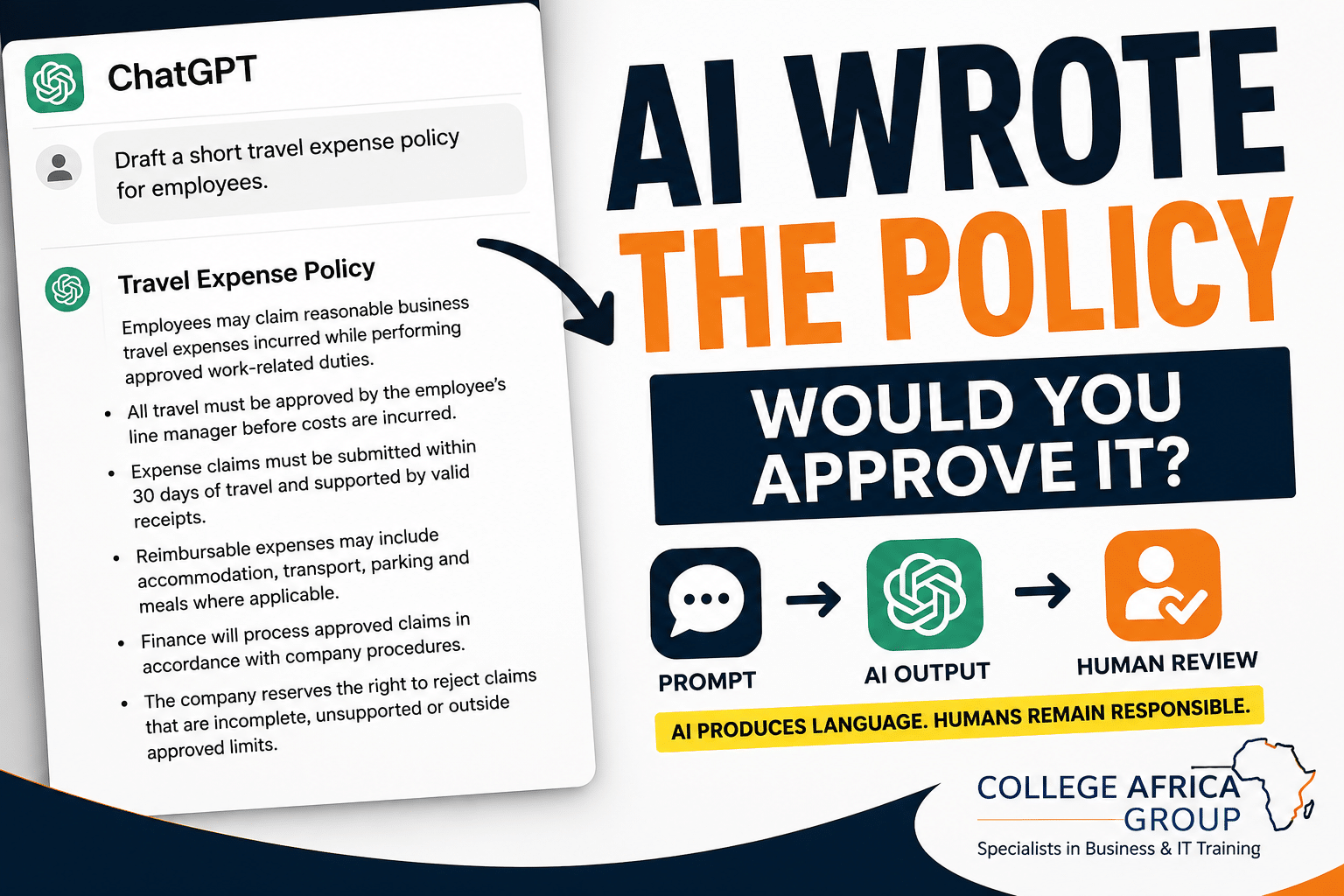
For this example, I asked ChatGPT to draft a simple travel expense policy using a very basic prompt. The result looked professional. The language was clear. The structure was logical. Many organisations could be tempted to use it immediately.
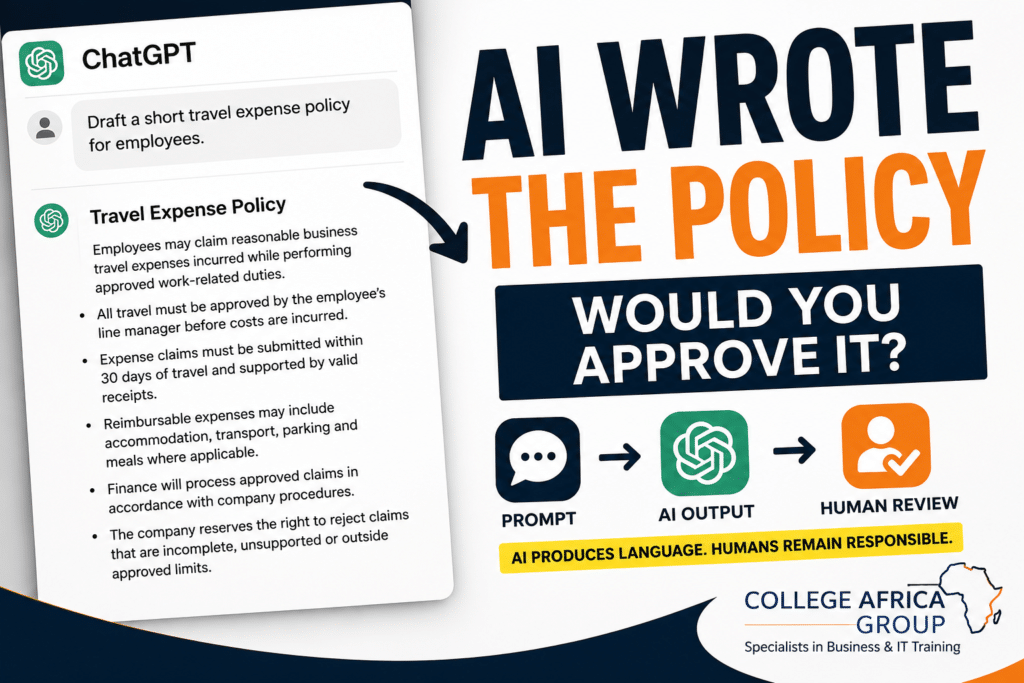 The problem is that ChatGPT does not know your company’s travel procedures, approval limits, reimbursement rules, internal controls or governance requirements.
Without additional information, AI can only produce a generic response based on patterns it has learned from other documents.
This highlights one of the most important lessons for businesses adopting AI. A document can sound correct without actually being correct for your organisation.
AI can help create a first draft. It cannot determine whether the content complies with your policies, legal requirements or operational procedures.
As AI tools such as ChatGPT and Microsoft Copilot become more common in the workplace, employees and managers need to understand where AI adds value and where human judgement remains essential.
AI may generate the first answer. Advanced Excel helps verify whether the answer is correct.
Watch the short video below to see the example and why validation matters.
YouTube AI Drafted a Travel Expense Policy in 30 Seconds. Here’s the Risk.
Download the YouTube transcript YouTube Travel Expense Policy Transcript
Why AI Risk Management Matters
Many organisations are adopting AI tools such as ChatGPT and Microsoft Copilot because they can produce content quickly and reduce the time required to create documents. However, the speed of AI does not remove the need for effective Risk Management.
AI systems generate responses based on patterns in data.
They do not understand your organisation’s policies, procedures, approval structures or compliance requirements unless this information is provided. As a result, AI-generated content may appear accurate while containing omissions, assumptions or recommendations that do not align with business requirements.
Effective AI Risk Management helps organisations balance productivity gains with appropriate controls and oversight.
Common AI Risk Management Challenges
The travel expense policy example highlights several common AI Risk Management challenges faced by businesses today.
Generic Content
AI often produces generic content that could apply to almost any organisation. While the wording may sound professional, important business-specific requirements are often missing.
Missing Internal Controls
A travel expense policy may require approval thresholds, spending limits, reimbursement rules and supporting documentation requirements. AI cannot determine these controls unless they are explicitly provided.
Compliance Risks
Organisations operating in regulated industries must ensure that policies and procedures align with legal, contractual and industry requirements. AI Risk Management includes reviewing AI-generated content to ensure compliance obligations are not overlooked.
False Confidence
One of the biggest AI Risk Management risks is that users may assume content is correct simply because it is well written. Professional language should never be confused with factual accuracy.
Risk Management Requires Human Judgement
AI can assist with drafting documents, generating ideas and improving productivity. However, AI Risk Management ultimately depends on human judgement.
Managers remain responsible for:
- Reviewing AI-generated content
- Validating facts and figures
- Ensuring compliance requirements are met
- Confirming that policies reflect organisational practices
- Approving final documents
AI can support decision-making, but it cannot accept accountability for the outcome.
Building an AI Risk Management Framework
Organisations should establish clear AI Risk Management guidelines before employees begin using AI tools extensively.
A practical AI Risk Management framework may include:
- Approved AI tools and platforms
- Data privacy requirements
- Document review procedures
- Validation and fact-checking requirements
- Management approval processes
- Employee training and awareness
These controls help ensure that AI-generated content is reviewed appropriately before being distributed or implemented.
Conclusion
This simple travel expense policy demonstrates why AI governance is becoming a critical business capability. ChatGPT created a professional-looking document within seconds, but it could not determine whether the policy reflected the organisation’s actual requirements.
The lesson is simple. AI can create content quickly. AI can improve productivity. AI can support employees in many aspects of their work.
However, effective AI Risk Management requires validation, oversight and human judgement.
AI produces language. People remain responsible for accuracy, compliance and decisions.
Watch the short video below to see the example and why validation matters.
YouTube AI Drafted a Travel Expense Policy in 30 Seconds. Here’s the Risk.
AI produces language. Humans remain responsible for the final decision.
Does College Africa Group offer AI Risk Management training?
Yes. College Africa Group offers practical AI Risk Management training designed to help employees and managers understand the opportunities, limitations and risks associated with Artificial Intelligence in the workplace. The training includes AI governance, validation techniques, responsible AI use, compliance considerations and practical workplace examples.
What AI workshops does College Africa Group provide?
College Africa Group offers a range of AI workshops, including:
- AI in the Workplace Training
- ChatGPT for Business Workshops
- Microsoft Copilot Training
- AI Governance and AI Risk Management Workshops
- AI and Data Analytics Training
- Customised AI Awareness Sessions for Management Teams
Workshops can be delivered onsite, virtually or as part of a broader AI adoption programme.
Can AI Risk Management training be customised for our organisation?
Yes. AI Risk Management workshops can be customised to reflect your organisation’s policies, procedures, compliance requirements, governance framework and industry-specific risks. This ensures employees learn how AI applies to their actual work environment.
Who should attend AI Risk Management training?
AI Risk Management training is suitable for:
- Executives and Senior Managers
- HR Professionals
- Finance Teams
- Project Managers
- Compliance and Risk Officers
- Team Leaders
- Employees using ChatGPT, Copilot or other AI tools
Any employee using AI in their daily work can benefit from understanding AI risks, controls and governance requirements.
Can College Africa Group provide onsite AI workshops in South Africa?
Yes. College Africa Group delivers AI workshops and AI Risk Management training throughout South Africa and Southern Africa. Training can be conducted onsite at your premises, virtually through Microsoft Teams or Zoom, or at a venue of your choice.
Frequently Asked Questions About AI Risk Management
What is AI Risk Management?
AI Risk Management is the process of identifying, assessing and controlling the risks associated with the use of Artificial Intelligence in the workplace. This includes risks related to accuracy, compliance, privacy, governance, decision-making and the use of AI-generated content.
Why is AI governance important?
AI Risk Management is important because AI tools can generate incorrect, incomplete or misleading information while appearing confident and professional. Organisations must ensure that AI-generated content is reviewed and validated before it is used for business decisions, policies or communications.
Can ChatGPT create company policies?
ChatGPT can help draft policies and procedures, but it cannot determine whether the content reflects your organisation’s actual requirements. Effective AI Risk Management requires human review, validation and approval before AI-generated policies are implemented.
Does Microsoft Copilot eliminate AI risks?
No. Microsoft Copilot can improve productivity and help employees work more efficiently, but AI Risk Management remains essential. Users must still verify information, review outputs and ensure compliance with organisational policies and procedures.
What are the biggest AI risks in the workplace?
Common AI governance concerns include inaccurate information, missing controls, compliance issues, privacy risks, bias, overreliance on AI and the use of unverified AI-generated content in business decisions.
Who is responsible for AI-generated content?
The organisation and its employees remain responsible for the accuracy and appropriateness of AI-generated content. AI tools assist users but do not assume legal, regulatory or management responsibility for decisions or actions taken.
How can businesses reduce AI risks?
Businesses can improve AI Risk Management by establishing governance policies, providing employee training, implementing review processes, validating AI outputs and defining clear responsibilities for approval and oversight.
Is AI Risk Management only relevant to large organisations?
No. AI Risk Management is relevant to organisations of all sizes. Small and medium-sized businesses face many of the same risks as larger organisations when employees use AI tools to create policies, reports, emails or business documents.
What is the relationship between AI governance and AI Risk Management?
AI governance provides the policies, controls and oversight framework for the use of AI. AI Risk Management forms part of this framework by identifying and addressing potential risks associated with AI-generated content and AI-assisted decision-making.
Can AI replace human judgement?
No. AI can generate suggestions, draft content and support decision-making, but human judgement remains essential. Effective AI governance recognises that people remain accountable for accuracy, compliance and business outcomes.

You may also like