AI Productivity Training – Do AI Fees Justify the Time Saved?
AI Productivity Training – Do AI Fees Justify the Time Saved?
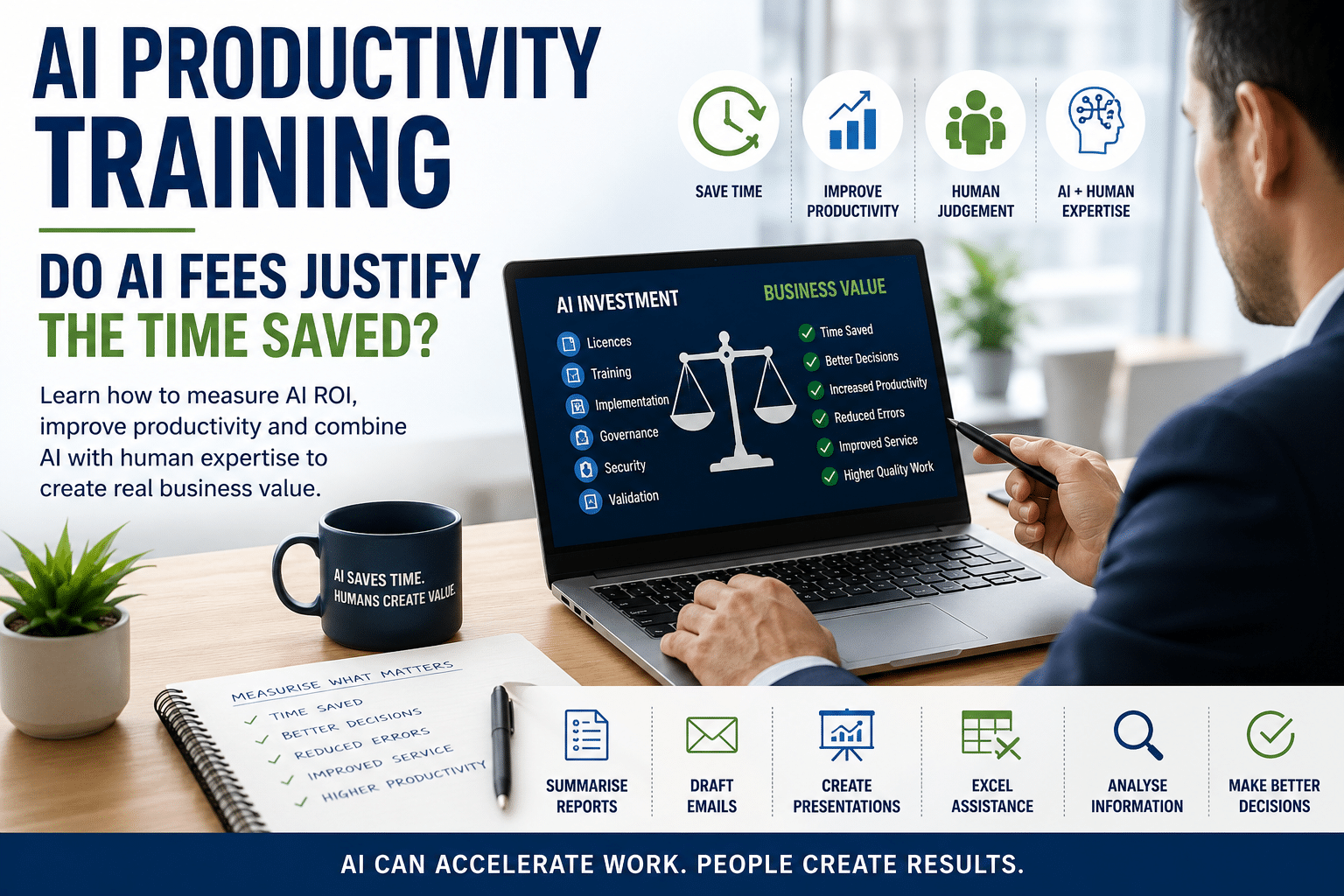
AI Productivity Training is helping businesses move beyond AI hype and focus on a more practical question: do AI fees justify the time saved?
Many organisations are investing in ChatGPT, Microsoft Copilot, Claude and other AI tools to improve workplace efficiency. Employees are using AI to draft emails, summarise meetings, analyse information, create presentations and assist with research.
The technology is impressive. But the business question is becoming more important.
Are the productivity gains worth the cost?
Related Reading: The Hidden Cost of AI
Many organisations evaluating AI are focused on subscription costs, licensing fees, and implementation budgets. However, the real cost of AI often extends far beyond the monthly fee.
In our recent article, The Hidden Cost of AI – What Microsoft, Uber and Other Businesses Are Discovering, we explored how leading organisations are finding that successful AI adoption requires employee training, governance, validation processes, change management, and ongoing oversight.
Read the article here:
https://mypr.co.za/do-ai-fees-justify-the-time-saved/
Understanding these hidden costs is important because it changes the question from “How much does AI cost?” to “What business value does AI create?”
Once organisations understand the full investment required, they can begin measuring whether AI is genuinely improving productivity, reducing repetitive work, improving decision-making, and delivering a meaningful return on investment.
AI Productivity Training and the Question of AI Value
For many businesses, AI spending is no longer limited to a monthly subscription. There are licence fees, training costs, implementation costs, governance requirements, security reviews and validation processes.
This means the real investment often extends far beyond the software itself.
AI Productivity Training helps organisations understand where AI creates value, where it introduces risk, and how employees should use AI responsibly in daily workplace tasks.
The question is no longer simply:
Are employees using AI?
The better question is:
Is AI saving enough time and improving enough outcomes to justify the cost?
Do employees really understand AI in the Workplace
AI Usage Is Not the Same as AI Productivity
Many businesses can measure AI usage quite easily. They know how many licences they have purchased, how many employees are using AI tools, and how much they are spending each month.
What is harder to measure is business value.
Are reports being completed faster? Are errors being reduced? Are customers receiving better service? Are employees producing better quality work?
This is where AI Productivity Training becomes important. It helps employees use AI for measurable workplace outcomes rather than simply experimenting with prompts.
AI Saves Time, But Humans Create Value
One of the biggest misconceptions about AI is that it exists mainly to replace employees.
In practice, many organisations are discovering that the greatest value comes from combining AI capabilities with human expertise.
AI is highly effective at summarising information, creating first drafts, analysing data, identifying patterns and accelerating routine tasks.
Humans remain essential for judgement, context, communication, customer relationships, decision-making and accountability.
AI can summarise a lengthy report in seconds. A manager still needs to decide what action should be taken.
AI can suggest an Excel formula. An employee still needs to verify that the result is correct.
AI can draft a customer email. A staff member still needs to ensure that the response is accurate, professional and aligned with company policy.
AI can create a presentation. A manager still needs to decide whether the recommendations make business sense.
This is why AI Productivity Training should focus on collaboration between people and technology, not replacement.
The Hidden Costs of AI in the Workplace
When organisations evaluate AI investments, they often focus only on subscription fees.
However, hidden AI costs can include staff training, security reviews, governance, Excel error validation, rework, compliance checks and change management.
An AI-generated report that contains incorrect information can create significant costs if errors are not identified before decisions are made.
This is especially important in finance, administration, reporting, project management and Microsoft Excel, where small errors can affect decisions, budgets and customer service.
AI Productivity Training helps employees understand how to use AI efficiently while still checking accuracy and maintaining accountability.
What Businesses Should Measure Instead
Instead of measuring only AI activity, organisations should measure practical workplace outcomes.
- Time saved on repetitive tasks
- Faster report preparation
- Reduced rework
- Improved customer service
- Better decision-making
- Improved productivity
- Reduced administrative workload
- Better quality of communication
These outcomes provide a much clearer picture of AI value than licence numbers or prompt counts alone.
The Core Skills Businesses Still Need
As AI adoption increases, several workplace skills are becoming more important rather than less important.
- Critical thinking
- Business judgement
- Data analysis
- Problem solving
- Communication
- Report validation
- Microsoft Excel skills
- Decision-making
- Customer relationship management
- Accountability
AI can accelerate many tasks. But employees still need the skills to verify information, identify errors, interpret results and make sound business decisions.
AI Productivity Training for South African Businesses
For South African businesses, AI Productivity Training should be practical, workplace-focused and linked to real tasks.
Employees do not only need to know how to enter prompts. They need to know when to use AI, when not to use AI, how to check AI outputs, and how to protect confidential information.
This is especially important for HR teams, finance departments, administrators, managers and professionals who work with reports, spreadsheets, client communication and business decisions.
The organisations that benefit most from AI may not be those that use the most AI.
They may be the organisations that combine AI productivity with human expertise, accountability and sound business judgement.
What Comes Next?
Understanding the cost of AI is only the first step. The next challenge is determining whether AI usage is actually creating business value.
Many organisations are now discovering that employee AI adoption and AI productivity are not the same thing. Measuring prompts, subscriptions, or usage statistics does not necessarily indicate improved performance or better business outcomes.
Read our related article:
AI Usage Is Not Productivity
https://collegeafricagroup.com/ai-usage-is-not-productivity/
The organisations achieving the greatest success with AI are focusing on outcomes, business value, decision quality, and measurable productivity improvements rather than AI usage alone.
Conclusion: Do AI Fees Justify the Time Saved?
AI can save time. AI can create drafts. AI can accelerate work.
But AI alone does not create business value.
Business value comes from employees who use AI wisely, verify the outputs, apply judgement and make better decisions.
The future of work is unlikely to be AI versus humans.
It is more likely to be AI and humans working together to achieve better outcomes than either could achieve alone.
AI saves time. Humans create value.
Related Resources:
- AI in the Workplace Training
- ChatGPT for Business Course South Africa
- Microsoft Copilot Training South Africa
- Advanced Excel Executive Course
Additional Reading:
Learn More About AI Productivity Training
College Africa Group provides practical AI Productivity Training and AI in the Workplace training for organisations that want to use AI responsibly, productively and effectively.
Explore AI in the Workplace Training
For corporate training enquiries, contact College Africa Group – +27 (0) 83 778 4903 | collegeafricagroup.com
Frequently Asked Questions About AI Productivity Training
What is AI Productivity Training?
AI Productivity Training teaches employees how to use AI tools such as ChatGPT, Microsoft Copilot and Claude to save time, draft content, summarise information, improve reporting and support workplace productivity while maintaining human judgement and accountability.
Do AI fees justify the time saved?
AI fees can be justified when employees save meaningful time, reduce repetitive work, improve reporting speed and make better decisions. However, businesses should measure real outcomes rather than simply counting licences, prompts or AI usage.
Does AI replace employees?
In most workplaces, AI is more useful as a productivity partner than as a full employee replacement. AI can assist with drafts, summaries and research, but people remain responsible for accuracy, judgement, customer relationships and final decisions.
What are the hidden costs of AI?
Hidden AI costs may include training, governance, security checks, validation, rework, compliance reviews and process redesign. These costs should be considered when businesses evaluate whether AI is delivering a real return on investment.
Why is human judgement still important when using AI?
AI can generate confident answers that may still be incorrect. Human judgement is needed to verify facts, check calculations, interpret context, identify errors and decide whether AI-generated work is suitable for business use.
How can AI improve workplace productivity?
AI can improve productivity by helping employees summarise documents, draft emails, prepare reports, create presentations, analyse information and reduce repetitive administrative work. The best results come when employees verify and improve AI outputs.
Why are Excel skills still important in the AI era?
Excel skills remain important because AI-generated formulas, summaries and spreadsheet outputs still need to be checked. Employees must understand data structure, calculations and reporting logic to verify whether AI-generated results are accurate.
Who should attend AI Productivity Training?
AI Productivity Training is useful for managers, HR teams, finance staff, administrators, project teams, executives and professionals who want to use AI tools effectively while maintaining accuracy, accountability and good business judgement.

You may also like