
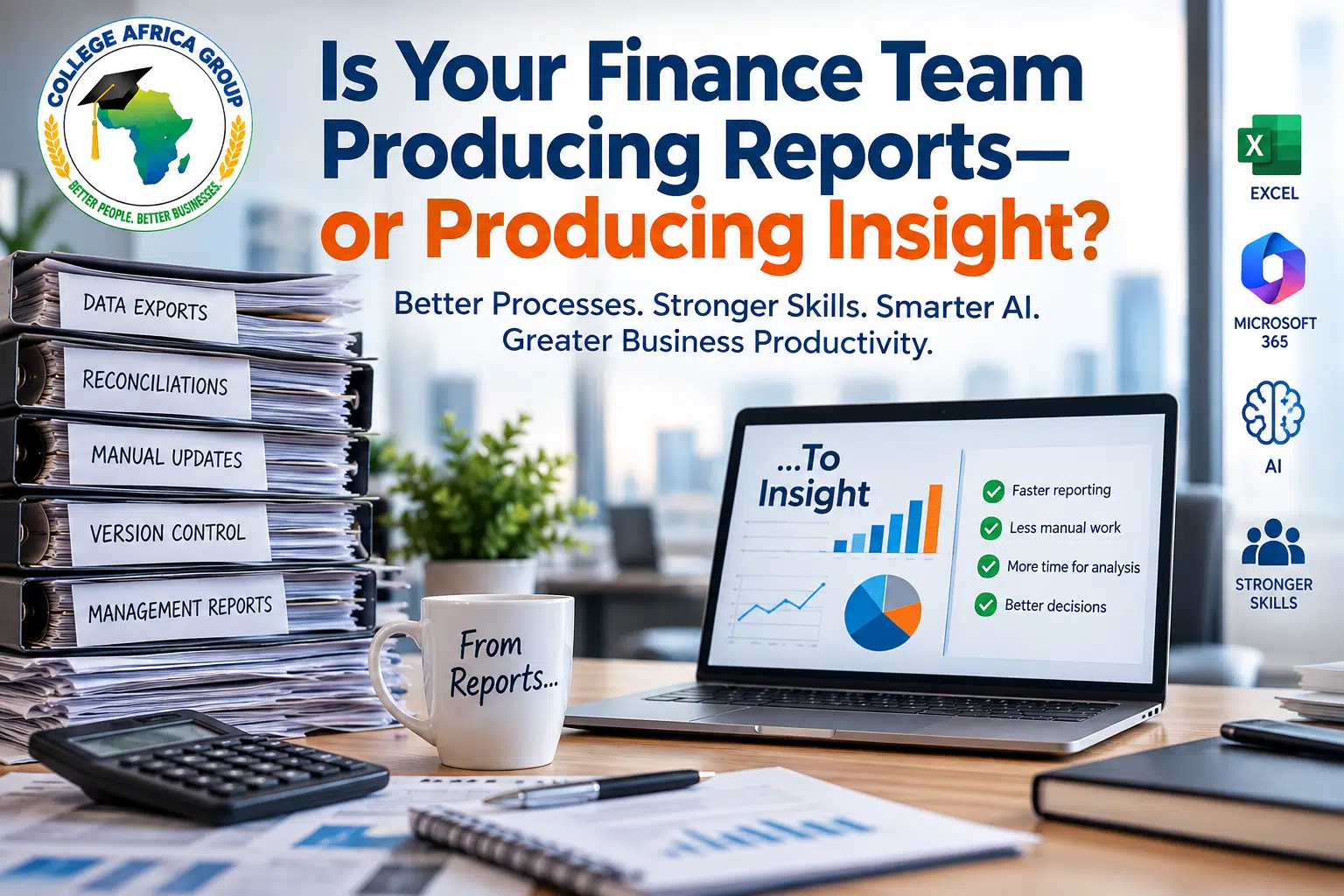
Is Your Finance Team Producing Reports—or Producing Insight?
Is Your Finance Team Producing Reports—or Producing Insight?
CAG Executive Question of the Week
How much of your finance team’s time is spent producing the numbers rather than understanding what those numbers are telling the business?
 Finance team productivity is not simply about producing reports faster.
The real opportunity is to reduce the work required to prepare reliable financial information so skilled finance professionals can spend more time analysing performance, identifying risks and helping management make better decisions.
Artificial intelligence can help, alongside Microsoft Excel, Microsoft 365, automation and stronger workplace skills. However, none of these should automatically be the starting point.
The starting point is understanding how the work gets done.
The Month-End Reporting Problem Is Familiar
It is the third working day of the month, and management wants the latest figures.
Data is exported from the accounting system, an Excel workbook is updated, additional information arrives from another department, and figures are incorporated into the management report. Then something does not reconcile.
A finance employee starts investigating. A formula may have been overwritten, a department may have submitted an older spreadsheet, a transaction may have been classified differently or the source information may have changed.
Eventually, the numbers balance and the report goes to management.
Nothing about this process necessarily looks disastrous. In fact, it may have been happening successfully every month for years. That is precisely why it deserves attention.
The finance team may have become extremely efficient at managing an inefficient process.
Hours of skilled employee time can disappear into extracting, copying, checking, reconciling, correcting and formatting information before meaningful financial analysis even begins. Improving finance team productivity means reducing this unnecessary work without compromising the reliability of the information.
The report gets produced, but the business needs more than a report. It needs insight.
Finance Team Productivity Is Bigger Than Excel
EY South Africa identified four common pain points affecting CFOs across industries: establishing dependable data, maintaining a connected understanding of business performance, improving financial reporting efficiency and enabling finance professionals to spend more time on higher-value activities.
EY also makes an important point about reporting complexity: improving financial reporting is not simply a matter of implementing everything into one new technology or platform.
EY South Africa — The Four Pain Points Common to CFOs in Every Industry
This distinction matters because organisations often respond to productivity problems by looking for another technology solution. A new finance system, AI application or automation platform may help, but the technology selected should depend on the business problem that needs to be solved.
At College Africa Group, we believe improving finance team productivity starts by understanding the journey from the source data to the information management actually needs.
Source Data → Process → Required Output → Skills & Technology → AI → Human Validation → Business Insight
This changes the conversation from finding somewhere to use AI to identifying where productive time is being lost and selecting the appropriate solution.
Finance Team Productivity Depends on What Happens Between the Source and the Report
Consider everything that happens between a transaction entering a business system and financial information reaching management.
Information may be exported from several systems, spreadsheets combined, data cleaned, formulas updated, figures reconciled and missing information requested from other departments.
Different versions of workbooks may circulate between employees, reports may need to be reformatted, and errors can create additional checking and rework.
Each activity may appear relatively small. Repeated across employees, departments, reports and twelve month-end cycles, the cumulative cost can become substantial.
This is also where organisations sometimes misdiagnose the finance team productivity problem.
Excel errors receive the blame because employees spend so much time working in Excel, when Excel may simply be the place where the underlying process problem becomes visible.
A recurring data-cleaning exercise might be better handled through Power Query. Repeated copying between worksheets may indicate a workbook design problem.
Complicated reconciliations may require stronger Excel capability or a redesigned process, while multiple versions of management information may point to a source-data or collaboration problem.
Improving finance team productivity does not require eliminating spreadsheets. It requires eliminating unnecessary work and making better use of the tools employees already have.
Finance Team Productivity Starts With the Process, Not AI
The arrival of Microsoft Copilot, ChatGPT and other AI tools creates another temptation: automate whatever employees are currently doing.
That can produce impressive demonstrations without necessarily producing meaningful business improvement.
If an employee spends three hours creating a report that nobody uses, reducing the process to 30 minutes makes the activity faster without making it valuable.
This is why process improvement needs to come before automation.
Once the workflow has been examined, different problems can receive appropriate solutions. A finance employee manually cleaning recurring datasets may benefit from Power Query, while another employee may need stronger Advanced Excel skills.
Document comparison and management commentary may be suitable for AI assistance, while an inefficient approval process may simply require redesign.
The best finance team productivity improvement may involve a combination of AI, Excel, Microsoft 365, stronger employee skills, process redesign or simply removing an unnecessary step altogether.
Technology supports a good business process. It does not make a poor process good.
AI Can Create More Time for Valuable Finance Work
The most valuable opportunity appears after repetitive work has been reduced.
EY argues that technology can allow finance professionals to spend less time on repetitive activities and more time analysing insights and driving business improvement.
The article describes the opportunity as allowing finance professionals to concentrate more on the “so what” contained in the data.
This is where finance team productivity becomes strategically important.
Saving five hours has limited value if those five hours simply disappear into another administrative activity.
The greater return comes when recovered time is redirected towards analysing margins, identifying unusual cost movements, examining debtor behaviour, improving forecasts, assessing cash-flow risks and explaining the financial consequences of management decisions.
This moves finance from producing information towards interpreting it.
AI can assist with that transition. A finance professional could use AI to investigate a dataset, understand an unfamiliar formula, compare documents, structure financial commentary, summarise lengthy information or convert analysis into a clearer management presentation.
However, faster analysis also creates the possibility of faster mistakes.
An AI-generated answer can appear professional even when the underlying interpretation is wrong. A sophisticated formula can contain a logical error, a financial summary can omit material information and an analysis can be based on incomplete source data.
For finance teams, the principle should remain:
Source Data → Process → Required Output → AI → Validate Against the Source
AI productivity can assist in producing the output. Finance professionals remain responsible for determining whether that output can be trusted.
Stronger Skills Improve Finance Team Productivity
One of the more dangerous assumptions surrounding AI is that businesses will need fewer Excel, analytical or workplace skills because AI can perform some of the work.
In practice, stronger skills can make AI more useful.
An experienced Excel user is better equipped to recognise a formula that does not make sense. A finance professional who understands the source data can challenge an AI-generated analysis, while an employee who understands the business process can distinguish genuine productivity improvement from automation for automation’s sake.
This is why businesses should not view Advanced Excel training, Microsoft 365 skills and AI adoption as competing investments. They increasingly support one another and can collectively improve finance team productivity.
A capable employee using appropriate technology within a well-designed process is considerably more valuable than simply giving an employee another AI licence.
Finance Team Productivity Should Be Measurable
Improving finance team productivity should ultimately produce a measurable business result.
A recurring process such as monthly management reporting provides a useful example.
The organisation can establish the employee time required, the amount of manual intervention, the frequency of errors and rework, and the time between month-end and useful management information becoming available.
Once that baseline exists, the workflow can be improved.
Some steps may disappear, while others may be improved through stronger Excel skills or Power Query.
Microsoft 365 may simplify collaboration and reduce unnecessary versions, and AI may accelerate suitable elements of analysis, comparison or commentary. Human validation remains essential throughout the process.
The improved process can then be measured against the original baseline.
A management report that previously consumed two working days but can now be produced accurately in four hours represents a tangible finance team productivity improvement. More importantly, management can decide how the released capacity should be used.
The return is not that the organisation has implemented AI.
The return is that skilled employees have more time available to create value.
From Producing Numbers to Understanding the Business
The future of finance is not a choice between Excel and AI, and the objective should not be to remove people from financial analysis.
The opportunity is to combine better processes, trusted information, stronger workplace skills and appropriate technology so finance professionals spend less time preparing information and more time understanding the business.
EY’s CFO research reinforces the importance of trusted data, connected information, efficient reporting and higher-value finance work. The appropriate solution for an individual organisation, however, depends on what is happening inside its own workflows.
That is why College Africa Group starts with discovery.
AI Workflow Discovery examines the way work currently moves through an organisation, identifies where productive time is being lost.
It also helps to determine whether the appropriate response is process improvement, stronger workplace skills, better use of Microsoft 365, Excel automation or artificial intelligence.
Improving finance team productivity may require several of these interventions working together. The objective is not more technology. The objective is greater business productivity and better decisions.
The CAG Perspective on Finance Team Productivity
At College Africa Group, we believe finance team productivity starts with the business process rather than the latest technology.
Better Business Processes. Stronger Workplace Skills. Smarter AI. Greater Business Productivity.
Before investing in another productivity tool, understand where your finance team’s productive time is being lost.
College Africa Group’s AI Workflow Discovery helps organisations identify opportunities to improve processes, strengthen workplace skills and apply Microsoft 365 and AI where they can create measurable business value.
Where Is Your Finance Team Losing Productive Time?
If your finance team is spending too much time extracting data, correcting spreadsheets, reconciling information, formatting reports or repeating the same monthly processes, the first step is not necessarily more technology.
College Africa Group’s AI Workflow Discovery examines how the work is currently being done, where productive time is being lost, and whether the right solution is better processes, stronger Excel skills, Microsoft 365, automation, AI—or a combination of these.
The objective is simple: reduce repetitive work, improve accuracy and give your finance team more time to analyse the numbers and support better business decisions.
Explore AI Workflow Discovery:
AI Workflow Discovery South Africa
Speak to College Africa Group: WhatsApp 083 778 4903 or call 083 778 4903.
Frequently Asked Questions
What is finance team productivity?
Finance team productivity is the ability to produce accurate financial information and useful business insight efficiently while reducing unnecessary manual work, duplication, errors and rework.
Can AI improve finance team productivity?
Yes. AI can improve finance team productivity by assisting with analysis, document comparison, summaries, formulas, commentary and repetitive activities. Its value depends on the quality of the underlying process, source information and human validation.
Is Excel still important for finance teams using AI?
Yes. Excel remains an important finance tool, while strong Excel skills help employees understand and validate calculations and analysis produced with AI assistance.
Should finance teams automate their existing processes?
The existing process should first be examined for unnecessary steps, duplication and activities that no longer add value. Automation is most useful after the underlying workflow has been understood and improved.
Where can Microsoft Copilot and ChatGPT support finance teams?
Potential applications include assisting with Excel formulas and analysis, comparing documents, summarising information, drafting financial commentary and improving the presentation of management information.
Why is human validation important when using AI in finance?
AI-generated outputs can contain incorrect calculations, assumptions or interpretations. Finance professionals remain responsible for validating important outputs against trusted source information.
What is AI Workflow Discovery?
AI Workflow Discovery examines how work moves through an organisation and identifies where better processes, stronger workplace skills, Microsoft 365 or AI could reduce wasted time and improve finance team productivity.

You may also like
Is AI Delivering Operational or Strategic Value?