
Is AI Delivering Operational or Strategic Value?
Is AI Delivering Operational or Strategic Value?
During a recent workshop, a CEO asked an AI ROI question that many businesses are now starting to face:
“How do we know whether we are actually getting a return from AI?”
It is a good question. Simply using artificial intelligence does not mean a business is creating measurable value or achieving a meaningful AI ROI.
An employee might use ChatGPT to prepare a document in 20 minutes instead of an hour. A finance team might use AI and Excel to produce a monthly report in a few hours instead of two days.
Those are useful improvements. But they are primarily examples of operational value.
The bigger opportunity starts when those improvements affect the way the business performs and the decisions management can make.
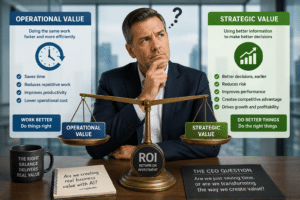 CAG Executive Question of the Week
Is AI simply helping your employees complete existing work faster, or is it helping your business make better decisions?
The Answer: AI Can Deliver Both
AI can create value at two different levels: Operational AI and Strategic AI. Understanding the difference is important when businesses start measuring AI ROI.
Operational AI focuses on productivity. It reduces repetitive work, speeds up reporting and helps employees complete everyday tasks more efficiently.
Strategic AI goes further. It asks whether faster processes and earlier information are helping management improve decisions, reduce risk or identify opportunities sooner.
Imagine a management report that normally reaches executives on the 15th of the month but can now be produced on the 2nd.
Producing it 13 days earlier is operational value. What management can do with those extra 13 days is potentially strategic value.
The Problem: Saving Time Does Not Automatically Prove AI ROI
Many organisations begin their AI ROI calculation by looking at hours saved. That is a useful starting point, but it does not tell the whole story.
If a process that previously required eight hours can now be completed in two, the organisation has achieved a measurable operational improvement.
But what happens to those six hours?
If employees simply fill the time with other low-value work, the financial return may be difficult to demonstrate. If that time is redirected towards customers, analysis, projects or other higher-value activities, the productivity benefit becomes more meaningful.
This is why AI ROI should not simply be calculated as employee hours saved multiplied by an hourly cost.
This is also why businesses need to look beyond AI adoption and focus on practical productivity outcomes. Our AI Productivity Training explores how organisations can use AI to save time while still asking whether the cost, effort and resulting business improvement justify the investment.
The same principle applies to information. Faster access to useful management information may be worth considerably more than the administrative time saved producing it.
Imagine the monthly management report again. Better business processes, stronger workplace skills and appropriate AI tools now make the report available on the 2nd instead of the 15th.
The strategic question is: What can management now do differently because it has that information 13 days earlier?
Perhaps margins are declining. Debtors are increasing. Costs are exceeding budget. Stock levels are becoming a problem.
Identifying those issues earlier gives management more time to act. That is where operational improvement can start creating strategic AI ROI.
Strategic AI Changes the Business Conversation
Consider stock management. Operational AI might help an employee analyse inventory information or prepare a stock report more quickly.
That saves time and improves productivity. It can form part of the organisation’s AI ROI, but there may be a much bigger opportunity.
Strategic AI could help management identify slow-moving or potentially obsolete stock earlier. The conversation then moves from producing a report to asking how much working capital is tied up, why particular stock is not moving and what action should be taken.
The value is not the AI-generated analysis itself. The value comes from the business decision that the information enables.
This distinction can apply across finance, sales, HR, operations, customer service and project management.
The AI ROI Solution: Start With the Business Process
One of the biggest mistakes businesses can make is starting with the AI tool.
They buy ChatGPT licences, activate Microsoft Copilot or experiment with another AI platform. Only afterwards do they start asking employees where the technology might be useful.
A better approach starts with the business objective and the workflow. Where are employees losing productive time? Which reports take too long? Where is information being entered more than once?
Which approvals create bottlenecks? Where are management decisions delayed because information arrives too late?
These are the questions that should drive AI Workflow Discovery South Africa.
Once the workflow is understood, the organisation can identify realistic opportunities, prioritise them and establish how the resulting AI ROI will be measured.
Sometimes AI will be part of the answer. Sometimes the bigger improvement may come from redesigning the process or strengthening employees’ Advanced Microsoft Excel and Microsoft 365 skills.
Technology should support a better business process. It should not simply make a poor process run faster.
Measure AI ROI Before and After the Change
A credible AI ROI calculation needs a baseline.
If a monthly reporting process currently takes 30 staff hours, requires three employees and reaches management on the 15th, record those figures before changing the process.
After improving the workflow and introducing appropriate technology, measure it again. Perhaps the report now takes 12 hours, requires less manual consolidation and reaches management on the 3rd.
The operational improvement can now be measured. The organisation has evidence rather than assumptions when discussing AI ROI.
Then ask the strategic question: What business outcome improved because management received better information earlier?
That could include faster intervention, reduced errors, improved customer response, better working-capital management, reduced risk or improved financial performance.
For executives, AI ROI should therefore measure both the efficiency gained and the value created from that improvement.
Arnold Muscat: Don’t Confuse AI Use With AI Value
Arnold Muscat, Director of College Africa Group, believes businesses need to distinguish between adopting AI and actually obtaining measurable value from it.
“Saving five hours a week is useful, but the bigger question is what the business does with those five hours. The same applies to information. If management receives an important report two weeks earlier, what decisions can it now make sooner?”
Muscat says the AI ROI conversation should not stop at the number of licences purchased, employees trained or people using AI.
“The question I would ask management is simple: What changed in the business? If we cannot answer that, we need to look more carefully at what we are measuring.”
Better Skills Can Improve AI ROI
AI does not remove the need for employees to understand the tools and information they work with every day.
A finance employee who understands Advanced Microsoft Excel can work more effectively with AI-assisted formulas and analysis. Strong underlying skills also help employees identify incorrect calculations, assumptions and conclusions.
Employees who understand Microsoft 365 can identify better opportunities for using Microsoft Copilot within Outlook, Word, Excel, PowerPoint and Teams.
ChatGPT for Business can assist with analysis, drafting, summarising and problem-solving. But these tools become more valuable when employees already understand the business process and the work they are trying to improve.
The best AI ROI is more likely to come from combining better processes, stronger workplace skills and appropriate technology than from the AI platform alone.
Human Validation Is Part of Responsible AI ROI
As AI moves from routine operational tasks towards strategic analysis, human validation becomes increasingly important.
AI can identify patterns, summarise information, suggest formulas and highlight possible issues. It can also misunderstand data, miss important business context or produce a convincing answer based on an incorrect assumption.
Excel is a good example of why this matters. ChatGPT and Copilot can help employees create formulas and analyse data, but they can also produce incorrect results. Our guide to types of errors in Excel explains why AI-generated formulas still require employees to understand the spreadsheet and validate the result.
Management remains responsible for the final decision. Human oversight and governance should therefore form part of any serious discussion about AI ROI.
AI produces language. People remain responsible for decisions.
Is Your Business Ready to Move From Operational to Strategic AI?
The starting point is not another AI licence. Start by understanding where work is being done inefficiently, where information is delayed and where better processes could create measurable value.
College Africa Group helps organisations identify these opportunities through AI Workflow Discovery and AI Consulting Services South Africa.
From there, the solution may involve better business processes, Advanced Microsoft Excel, Microsoft 365, ChatGPT, Microsoft Copilot or a combination of these.
The objective is not simply to use more AI. It is to improve business productivity and achieve a measurable AI ROI.
Start With AI Workflow Discovery
Can your organisation clearly explain its AI ROI in practical business terms?
If not, College Africa Group can help examine your existing workflows, identify where productive time is being lost and determine where AI could create meaningful operational and strategic value.
Our AI Workflow Discovery approach starts with the work, establishes measurable opportunities and helps organisations prioritise improvements before investing in more technology.
Contact College Africa Group to discuss where AI can create measurable value in your organisation.
Call 083 778 4903
|
WhatsApp College Africa Group
Better Business Processes. Stronger Workplace Skills. Smarter AI. Greater Business Productivity.
Frequently Asked Questions About AI ROI
What is AI ROI?
AI ROI measures the business value created from an investment in artificial intelligence compared with the cost of implementing, licensing, supporting and using it. Businesses should consider productivity, quality, risk and strategic outcomes rather than only hours saved.
How can a business measure AI ROI?
Start with a measurable baseline before changing the process. Compare time, cost, errors, rework, reporting speed or another relevant measure before and after implementation, and then determine whether the improvement contributed to a meaningful business outcome.
What is the difference between Operational AI and Strategic AI?
Operational AI helps employees complete work faster or more efficiently. Strategic AI uses improved information, analysis and capability to support better management decisions, reduce risk or improve business performance.
Does saving employee time automatically create an AI return?
No. Time saved is an important measure, but businesses should also determine how that released capacity is used. The value is greater when employees redirect time towards customers, analysis, decision-making, projects or other higher-value work.
Why is AI Workflow Discovery important for AI ROI?
AI Workflow Discovery examines how work is currently performed before recommending technology. This helps organisations identify bottlenecks, duplication and measurable opportunities, making it easier to establish realistic AI priorities and assess the resulting return.
Can Microsoft Copilot and ChatGPT improve AI ROI?
Yes, where they are applied to suitable workflows. ChatGPT and Microsoft Copilot can assist with communication, analysis, reporting and knowledge work, but business processes, employee skills and human validation remain important.
Why does human validation matter when measuring AI value?
AI-generated outputs can contain incorrect assumptions, missing context or errors. Human oversight helps protect quality, accountability and decision-making, particularly when AI is being used for important financial, operational or strategic work.
Should AI ROI be measured once or continuously?
It should be reviewed regularly. Workflows, employee adoption, AI tools and business conditions change, so organisations should continue measuring whether AI is producing the expected operational and strategic outcomes.

You may also like
Is Your Finance Team Producing Reports—or Producing Insight?