
AI Productivity Training – One-Day Corporate Workshop
College Africa Group’s AI Productivity Training workshop helps employees use artificial intelligence more effectively, responsibly and confidently in everyday work.
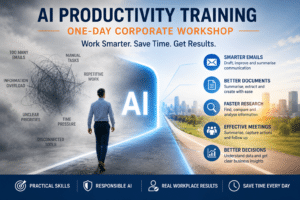 The programme is practical rather than technical. Participants work with realistic workplace activities such as emails, documents, research, meetings and business information while learning how to apply confidentiality, verification and human accountability.
Rather than starting with a particular AI product, the workshop starts with the business requirement:
Business Problem → Desired Outcome → Appropriate Tool → Context → Human Verification → Business Value
Participants are introduced to ChatGPT, Microsoft Copilot and other relevant AI tools, but the purpose is not to learn a collection of products.
The objective is to use AI to work better.
AI Productivity Training at a Glance
- Duration: One day
- Typical Time: 09:00–15:30
- Delivery: Onsite or virtual
- Audience: Corporate employees, managers and professionals
- Approach: Practical, interactive and business-focused
- Technical Level: No technical AI background required
- Tools: ChatGPT, Microsoft Copilot and other relevant workplace AI tools
What You Will Learn in AI Productivity Training
By the end of the workshop, participants should be able to:
- Understand where generative AI can improve everyday workplace productivity.
- Apply the CAG AI Decision Framework.
- Give AI clearer instructions and stronger business context.
- Recognise hallucinations, unsupported assumptions and confidentiality risks.
- Apply human verification to important AI-generated work.
- Use AI with emails, documents, research, meetings and business information.
- Understand practical applications of Microsoft Copilot and Microsoft 365.
- Identify repetitive workplace tasks that could potentially be improved.
- Consider whether AI has saved time, improved quality or reduced risk.
The CAG AI Decision Framework
Our AI Productivity Training uses a consistent business-first framework throughout the workshop.
1. Problem
What business problem am I trying to solve?
2. Information
What information can I safely use?
3. Outcome
What result am I trying to create?
4. Tool
Which AI, software or approach is appropriate?
5. Context
What information and instructions does it need?
6. Verify
How will I check the result?
7. Value
Did it save time, improve quality, reduce cost or reduce risk?
The framework helps participants avoid one of the most common workplace AI mistakes: starting with the technology instead of the business problem.
The Four Levels of AI Use
The workshop introduces the CAG Four Levels of AI Use.
Level 1 – AI Assistant
Everyday productivity such as emails, summaries, documents, agendas and meeting notes.
Level 2 – AI Analyst
Using AI to understand information, reports, spreadsheets, comparisons, trends and business data.
Level 3 – AI Researcher
Using AI to support market, competitor, industry, policy and general business research.
Level 4 – AI Workflow Partner
Moving beyond individual tasks to consider reporting, meetings and multi-step business processes.
The one-day AI Productivity Training programme concentrates primarily on practical workplace productivity while introducing participants to the opportunities available at the more advanced levels.
One-Day AI Productivity Training Programme
Session 1 – Think Before You AI
The workshop begins with a concise introduction to generative AI and its role in the workplace.
Participants explore:
- What generative AI is and what it is not.
- What AI does well and where it struggles.
- ChatGPT, Microsoft Copilot, Claude, Gemini and other relevant tools.
- Free versus paid and business AI environments.
- Confidentiality, privacy and responsible AI use.
- The Four Levels of AI Use.
- The CAG AI Decision Framework.
Practical Exercise
Participants identify three repetitive tasks they regularly perform and consider where AI could potentially help.
A short AI Risk Challenge explores whether different types of workplace information are appropriate to use with AI.
Session 2 – Prompting, Verification & Responsible AI
Prompt Failure Lab
Participants see how the quality of an AI response changes when the quality of the instruction changes.
The workshop moves from a vague request towards a structured business instruction using:
Role → Task → Context → Source → Output → Constraints → Verification
Participants learn to provide context, define the required outcome, ask AI to clarify missing information and refine responses conversationally.
Hallucinations & Human Verification
A practical demonstration shows why an AI response can sound convincing and still be incorrect.
The CAG Human Check asks:
- What could be wrong?
- What has AI assumed?
- What requires verification?
- Is the information appropriate to share?
- Who remains accountable?
AI produces language and analysis. Humans remain responsible for judgement and accountability.
Session 3 – AI Productivity Training for Everyday Work
This is the main practical section of the workshop. Participants apply AI to realistic workplace activities rather than simply learning software features.
Emails & Communication
Use AI to draft and improve emails, adjust tone, shorten lengthy communication, summarise threads, identify actions and prepare follow-ups.
Documents & PDFs
Summarise documents, extract key information, compare content, identify gaps and prepare concise business or executive summaries.
Research
Use AI to investigate business questions, compare options and assist with market, competitor, industry or policy research while checking sources and dates.
Business Information & Data
Explore how AI can help explain information, interrogate simple business data, identify patterns and prepare management summaries.
Where useful, ChatGPT and Microsoft Copilot can be compared on the same task to demonstrate that the appropriate tool depends on the business requirement and information involved.
Session 4 – Meetings, Microsoft 365 & Workplace Productivity
Participants see how AI can turn meeting information into usable business work:
Meeting → Transcript → Summary → Decisions → Actions → Responsibilities → Follow-Up → Next Agenda
Practical examples may also demonstrate AI within:
- Outlook
- Word
- Excel
- PowerPoint
- Teams
- Microsoft Copilot
The focus is not on teaching every Microsoft Copilot feature. It is on understanding how AI can improve productivity across a real workplace workflow.
AI Productivity Training and Better Business Processes
The final part of the workshop introduces participants to an important principle:
Do not automate a broken process.
Participants are introduced to:
Fix → Standardise → AI Assist → Automate → Measure
They return to the repetitive tasks identified earlier and consider whether the work could first be simplified, standardised or improved before AI or automation is introduced.
This also introduces the concept of AI Workflow Discovery without turning the one-day workshop into a process consulting engagement.
Measuring the Value of AI Productivity Training
Using AI does not automatically create business value.
Participants are encouraged to consider whether AI has:
- Saved time.
- Improved quality.
- Reduced errors or rework.
- Reduced risk.
- Improved consistency.
- Released useful capacity.
This keeps AI Productivity Training focused on measurable workplace outcomes rather than AI use for its own sake.
Practical Clinic, Action Plan & Q&A
The workshop concludes with participants applying the learning to their own work.
Each participant considers:
- Immediate Task: Where can I use AI now?
- Process: What repetitive work could be improved?
- Risk: What information or governance issue should I consider?
- Verification: How will I check important AI outputs?
- Measure: How will I know whether AI actually helped?
Time is reserved for practical questions and relevant workplace scenarios.
AI Productivity Training Outcomes
Participants leave with:
- A practical understanding of workplace AI.
- The CAG AI Decision Framework.
- The Four Levels of AI Use.
- Improved approaches to prompting and context.
- A Human Check approach to verification.
- Practical exposure to AI for communication, documents, research and meetings.
- Identified productivity opportunities within their own work.
- A simple Personal AI Action Plan.
The outcome: I can use AI more effectively, responsibly and purposefully in my everyday work.
Choose the Right Level of AI Training
The one-day AI Productivity Training workshop is a complete standalone programme focused on practical workplace productivity.
Depending on your audience and objectives, College Africa Group also offers a shorter executive overview or a more in-depth two-day programme.
Need a High-Level Executive Overview?
For executives, senior managers and decision-makers who need a practical understanding of AI opportunities, governance, risk and business value without detailed software training, consider our:
Executive AI Training – Half-Day Corporate Workshop
This 3–4 hour executive workshop provides a high-level overview of workplace AI, responsible adoption, business opportunities and practical next steps for the organisation.
Want to Go Deeper?
Organisations wanting to move further into business data, Microsoft 365 workflows, process improvement, ROI and AI Workflow Discovery can progress to our:
Practical AI Training – Two-Day Corporate Workshop
The two-day programme moves beyond individual productivity and explores where AI could improve how business processes and workflows actually operate.
Need to Investigate Business Processes?
For organisations requiring detailed process investigation, workflow mapping, AI opportunity identification or automation assessment, College Africa Group also provides AI Workflow Discovery consulting.
Why Choose College Africa Group for AI Productivity Training?
College Africa Group takes a business-first approach to AI Productivity Training. Our programmes focus on improving how people work rather than simply demonstrating AI features.
Our approach combines:
- Practical workplace application using realistic business tasks and scenarios.
- CAG AI Decision Framework connecting AI use to genuine business requirements.
- Four Levels of AI Use — Assistant, Analyst, Researcher and Workflow Partner.
- Microsoft 365 and business productivity expertise, including Excel, Microsoft Copilot and workplace workflows.
- Human verification and responsible AI, with appropriate attention to confidentiality, governance and accountability.
- AI Workflow Discovery, helping organisations move beyond individual productivity towards process and workflow improvement.
- Corporate training experience tailored to South African organisations.
Better Processes. Stronger Skills. Smarter AI.
AI Productivity Training for Your Team
The one-day workshop can be delivered onsite or virtually and can incorporate appropriate examples relevant to your organisation and employees.
Download the course outline for HR, L&D, procurement or internal approval, or contact College Africa Group to discuss your requirements.
Frequently Asked Questions – AI Productivity Training
What is AI Productivity Training?
AI Productivity Training teaches employees how to apply artificial intelligence to everyday workplace activities such as emails, documents, research, meetings and business information. The focus is on saving time, improving quality and using AI responsibly.
Who should attend this one-day AI Productivity Training workshop?
The workshop is suitable for corporate employees, managers, team leaders, administrators and professionals who want to use AI more effectively in their everyday work. No technical AI or programming background is required.
Which AI tools are used during the workshop?
The workshop uses ChatGPT, Microsoft Copilot and other relevant AI tools where appropriate. The objective is not to teach one product, but to help participants select the right tool for the business requirement.
Does AI Productivity Training include Microsoft 365?
Yes. Practical examples may include Microsoft Copilot within Outlook, Word, Excel, PowerPoint and Teams. The emphasis is on improving workplace productivity rather than learning every Copilot feature.
Is responsible and secure AI use covered?
Yes. The workshop addresses confidentiality, sensitive business information, hallucinations, verification, approved AI environments and human accountability. Participants use the CAG AI Decision Framework and Human Check to support responsible AI use.
Will the workshop help us identify repetitive work that AI could improve?
Yes. Participants identify repetitive workplace tasks and consider whether the work could first be simplified or standardised before applying AI or automation. The workshop also introduces the principle: Fix → Standardise → AI Assist → Automate → Measure.
What will participants be able to do after the workshop?
Participants should be able to use AI more effectively for communication, documents, research, meetings and business information. They will also have a practical approach to prompting, verification, responsible AI use and identifying opportunities within their own work.
Can AI Productivity Training be customised for our organisation?
Yes. College Africa Group can incorporate appropriate examples relevant to your organisation, departments and business requirements. The workshop can be delivered onsite or virtually.
AI Productivity Training Resources
- Responsible AI/verification section:
Microsoft Responsible AI principles and approach - Privacy/confidentiality / POPIA section:
Information Regulator South Africa – POPIA and data protection