
Executive AI Training – Half-Day Corporate Workshop
College Africa Group’s Executive AI Training workshop gives executives, senior managers and decision-makers a practical, high-level understanding of artificial intelligence in the workplace.
This is not software training. The session focuses on where AI can create business value, what risks need to be managed, how leaders should evaluate AI opportunities and what sensible next steps may look like for the organisation.
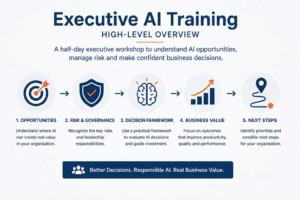 The workshop follows a business-first approach:
Business Problem → Desired Outcome → Appropriate Tool → Human Verification → Business Value
Participants see practical examples using ChatGPT, Microsoft Copilot and other relevant AI tools, but the focus remains on business decisions rather than product features.
Executive AI Training at a Glance
- Duration: Approximately 3–4 hours
- Delivery: Onsite or virtual
- Audience: Executives, senior managers, departmental heads and decision-makers
- Format: Executive briefing, live demonstrations, discussion and Q&A
- Approach: Strategic, practical and business-focused
- Technical Level: No technical AI background required
- Important: This is a high-level executive overview, not software training
What Executives Will Gain from the Workshop
By the end of the Executive AI Training session, participants should be able to:
- Understand the practical role, strengths and limitations of generative AI.
- Recognise where AI may improve productivity, analysis, research and business processes.
- Apply the CAG AI Decision Framework at a high level.
- Understand why context and clear instructions materially affect AI output.
- Recognise hallucinations, confidentiality risks and the need for human verification.
- Understand management responsibilities around responsible AI use.
- Identify potential AI opportunities within the organisation.
- Consider governance, adoption, risk and measurable business value.
- Identify sensible next steps for further training, pilots or AI Workflow Discovery.
The Four Levels of AI Use
The workshop introduces the CAG Four Levels of AI Use as a simple way for leaders to understand how workplace AI can progress from personal assistance to process improvement.
Level 1 – AI Assistant
Everyday productivity such as emails, summaries, documents, agendas and meeting notes.
Level 2 – AI Analyst
Using AI to understand reports, spreadsheets, business data, trends, comparisons and anomalies.
Level 3 – AI Researcher
Using AI to support market, competitor, industry, policy and executive research.
Level 4 – AI Workflow Partner
Moving beyond individual tasks to consider reporting, meetings and multi-step organisational processes.
The purpose of the Four Levels is not to rank AI products. It is to help leaders understand where different types of AI value may exist inside the organisation.
The CAG AI Decision Framework
Our Executive AI Training uses a simple business-first framework for evaluating AI opportunities.
1. Problem
What business problem are we trying to solve?
2. Information
What information can we safely use?
3. Outcome
What result do we need?
4. Tool
Which AI, software or approach is appropriate?
5. Context
What does the AI need to know?
6. Verify
How will the result be checked?
7. Value
Did it save time, improve quality, reduce cost or reduce risk?
The objective is to prevent one of the most common AI adoption mistakes: starting with the technology rather than the business problem and desired outcome.
1. Where Can AI Realistically Add Business Value?
The session begins with a concise overview of the current workplace AI landscape.
Topics include:
- What generative AI is and what it is not.
- Where AI performs well and where it remains unreliable.
- Brief positioning of ChatGPT, Microsoft Copilot, Claude, Gemini and other relevant workplace AI tools.
- Free versus business AI environments.
- Individual productivity versus organisational process improvement.
- Using the Four Levels of AI Use to identify potential opportunities.
Executive question: Where are we currently using AI, and where could it genuinely improve time, quality, cost or risk?
2. How Should Leaders Decide When and Where to Use AI?
Participants apply the CAG AI Decision Framework to a realistic business scenario.
The discussion considers:
- The business problem being solved.
- The desired business outcome.
- What information is required.
- Whether that information can safely be used.
- Whether AI is actually the most appropriate solution.
- Whether conventional software, automation or human judgement may be more suitable.
- How important outputs will be verified.
- Who remains accountable.
AI is an enabler. The business requirement comes first.
3. Why Instructions, Context and Verification Matter
Prompt Failure Lab
A short live demonstration shows how the same AI task changes when the quality of the instruction improves.
The demonstration progresses from a vague instruction to a structured business request using:
Role → Task → Context → Source → Output → Verification
This is not intended as a detailed prompting lesson. It demonstrates why context, source information and clear outcomes matter when employees use AI.
Hallucinations and Human Verification
A practical example demonstrates how AI can produce information that sounds convincing while still containing incorrect assumptions or unsupported statements.
The CAG Human Check asks:
- What could be wrong?
- What has AI assumed?
- What requires verification?
- Is the information appropriate to share?
- Who remains accountable?
Plausible does not mean correct.
4. What Can AI Actually Do in the Workplace?
The Executive AI Training workshop uses a small number of strong demonstrations rather than attempting to teach multiple software applications.
Documents and Communication
Examples may include summarising information, drafting communications, comparing documents and creating concise executive-ready outputs.
Analysis and Research
AI can assist with understanding information, identifying trends, comparing options and supporting business research while important sources and conclusions remain subject to verification.
Meetings
Participants see how meeting information can move through an end-to-end workflow:
Meeting → Transcript → Summary → Decisions → Actions → Responsibilities → Follow-Up → Next Agenda
Microsoft 365 and Copilot
Where relevant, Microsoft Copilot may be demonstrated within Outlook, Word, Excel, PowerPoint or Teams, with ChatGPT or another AI tool used for comparison.
The purpose is to understand which environment and tool are appropriate for the task, rather than declaring one AI platform the winner.
5. AI Risk, Governance and Management Responsibility
Responsible organisational AI adoption requires more than simply giving employees access to AI tools.
The executive discussion covers:
- Confidential, personal, client, financial and commercially sensitive information.
- Approved versus unapproved AI tools.
- Hallucinations and unsupported assumptions.
- Outdated or incorrect information.
- Over-reliance on AI output.
- Human review and accountability.
- Acceptable-use guidance and organisational controls.
- The roles of HR, IT, Legal, Information Security and business leadership.
Executive AI Risk Challenge
Participants consider several realistic workplace scenarios and discuss whether AI use is appropriate, what controls may be required and who should make the decision.
6. From Individual AI Tasks to Better Business Processes
The session moves from personal AI productivity towards a broader organisational question:
Are we simply making an existing task faster, or are we improving how the work gets done?
An important principle is introduced:
Do not automate a broken process.
The CAG process improvement sequence is:
Fix → Standardise → AI Assist → Automate → Measure
A simple workflow example is used to identify:
- Duplication.
- Unnecessary manual work.
- Standardisation opportunities.
- AI opportunities.
- Automation opportunities.
- Activities requiring human judgement.
This introduces AI Workflow Discovery as a structured way to investigate larger organisational opportunities.
7. Business Value, Adoption and Next Steps
Executive AI Training should ultimately lead to better decisions about where the organisation invests its time and resources.
Executives consider:
- Time saved.
- Quality improvements.
- Errors and rework.
- Cost.
- Risk reduction.
- Capacity released.
- Employee adoption.
- Approved tools.
- Governance.
- AI champions and internal support.
The workshop reinforces that:
Potential hours saved are not automatically financial savings.
Potential opportunities should be considered according to their business value, implementation effort and risk.
Executive Q&A and Live Business Scenarios
A substantial final Q&A allows participants to raise real organisational questions, discuss potential use cases and test the CAG AI Decision Framework against their own business environment.
The objective is not to leave executives with a list of AI features. It is to help them identify:
- Where immediate opportunities may exist.
- Where risk or governance requires attention.
- What should be investigated further.
- What may require additional staff training.
- Where a pilot may be appropriate.
- Where AI Workflow Discovery may add value.
Executive AI Training Outcome
I understand what AI can and cannot do, where it may create value in our organisation, the risks we need to manage and what we should investigate next.
Where to Go Next
The Executive AI Training workshop is designed as a high-level leadership overview.
Organisations wanting to progress further can consider:
- AI Productivity Training – One-Day Corporate Workshop: deeper hands-on workplace application for employees and teams.
- Practical AI Training – Two-Day Corporate Workshop: deeper application across business data, Microsoft 365, processes and workflows.
- AI Workflow Discovery: detailed investigation of organisational processes and AI or automation opportunities.
- Bespoke AI Consultancy support: for organisations developing policies, pilots and structured AI roll-out plans.
Looking for More Hands-On AI Training?
The Executive AI Training workshop provides a high-level leadership overview. For teams requiring more practical, hands-on application, College Africa Group also offers one-day and two-day corporate AI programmes.
AI Productivity Training – One-Day Workshop
A practical one-day programme focused on using AI more effectively for everyday workplace productivity, including communication, documents, research, meetings and Microsoft 365.
Practical AI Training – Two-Day Workshop
A deeper two-day programme covering workplace productivity, business data, Microsoft 365, process improvement, AI Workflow Discovery and measurable business value.
Why Choose College Africa Group for Executive AI Training?
College Africa Group takes a business-first approach to Executive AI Training. The objective is to help leaders understand practical opportunities, business risks and appropriate next steps rather than simply demonstrating AI technology.
Our approach combines:
- Practical workplace application using realistic business scenarios.
- CAG AI Decision Framework connecting AI use to genuine business requirements.
- Four Levels of AI Use — Assistant, Analyst, Researcher and Workflow Partner.
- Microsoft 365 and business productivity expertise, including Excel, Microsoft Copilot and workplace workflows.
- Human verification and responsible AI, with appropriate attention to confidentiality, governance and accountability.
- AI Workflow Discovery, helping organisations move beyond individual productivity towards process and workflow improvement.
- Corporate training experience tailored to South African organisations.
Better Processes. Stronger Skills. Smarter AI.
Executive AI Training for Your Leadership Team
The workshop can be delivered onsite or virtually and can be adapted to reflect your organisation’s leadership priorities, AI environment and business requirements.
Download the abridged Executive AI Training course outline or contact College Africa Group to discuss your requirements.
Frequently Asked Questions – Executive AI Training
What is Executive AI Training?
Executive AI Training is a high-level workshop for leaders who need to understand where artificial intelligence can create business value, what risks it introduces and how to make informed decisions about adoption, governance and next steps.
Who should attend this half-day Executive AI Training workshop?
The workshop is designed for executives, senior managers, departmental heads and decision-makers who need a practical overview of AI without detailed software training.
Is this a technical AI course?
No. This is an executive-level overview, not software training. The focus is on business opportunities, risk, governance, decision-making, adoption and measurable value.
Which AI tools are covered?
The workshop may reference or demonstrate tools such as ChatGPT, Microsoft Copilot, Claude and Gemini where relevant. The objective is not to teach product features, but to help leaders understand which tools may be appropriate for different business requirements.
Does Executive AI Training cover AI governance and risk?
Yes. The workshop covers confidentiality, sensitive information, approved and unapproved AI tools, hallucinations, verification, human accountability and organisational governance responsibilities.
What is the CAG AI Decision Framework?
The CAG AI Decision Framework helps leaders evaluate AI opportunities through seven questions: Problem, Information, Outcome, Tool, Context, Verify and Value. It keeps the discussion focused on business requirements rather than technology alone.
Will the workshop help us identify AI opportunities in our organisation?
Yes. The session helps leaders identify potential opportunities across individual productivity, analysis, research and business workflows while considering business value, risk and implementation priorities.
What happens after the Executive AI Training workshop?
Depending on the opportunities identified, the next step may be internal action, a pilot, further staff training, the one-day or two-day AI programmes, or a more detailed AI Workflow Discovery consulting engagement.
Two authoritative links for the Executive AI Training page:
- Microsoft Responsible AI — place this in “AI Risk, Governance and Management Responsibility”, linked from wording such as responsible AI principles.
Microsoft Responsible AI - Information Regulator South Africa — place this where you discuss confidential, personal and sensitive information, linked from wording such as South African data protection and POPIA requirements.
Information Regulator South Africa