
Before Buying More AI Licences, Ask These 16 Questions AI Workflow Discovery
- Posted by @1TrainingCollegeInSA
- Date June 30, 2026
 Employees begin experimenting with AI. New licences are deployed. Management anticipates faster workflows, improved efficiency and measurable business value.
Yet a few months later, many organisations find themselves asking the same questions:
- Why are employees not using AI consistently?
- Why are productivity improvements difficult to measure?
- Why has adoption slowed after the initial excitement?
- Where is the ROI we expected?
An AI Workflow Discovery assessment helps organisations understand how work is currently performed, where productivity bottlenecks exist, which tasks are repetitive and where AI can deliver measurable business value.
Rather than starting with technology, AI Workflow Discovery focuses on workflows, people and business outcomes.
The reality is that purchasing AI licences is usually the easy part.
Successful AI adoption depends on understanding how work is currently performed, identifying productivity bottlenecks, improving employee skills, establishing governance and integrating AI into real business workflows.
Without this foundation, even the most advanced AI tools can become underutilised software that delivers far less value than anticipated.
This is why AI Workflow Discovery should be one of the first steps organisations consider before investing further in AI technologies.
It helps identify where time is being lost, where repetitive work exists, which processes can benefit from AI assistance and how productivity improvements can be measured and demonstrated over time.
Why are employees not using the tools consistently?
Why are productivity improvements difficult to measure?
Where is the ROI we expected?
The answer is often not the technology itself.
Successful AI adoption depends on people, processes, skills, governance and understanding how work is actually performed.
This is where AI Workflow Discovery becomes valuable.
Why AI Workflow Discovery Matters
Table of Contents
ToggleMany organisations approach AI as a software project.
- Licences are purchased, including Office 365
- Training is delivered.
- Employees gain access to ChatGPT or Microsoft Copilot.
- Management expects productivity improvements to follow automatically.
- Unfortunately, productivity does not come from AI alone.
Productivity improvements occur when employees change the way they perform tasks, reduce repetitive work, improve decision-making and integrate AI into daily workflows.
Without adoption, workflow improvements and leadership support, AI can quickly become expensive software that delivers limited value.
The Most Overlooked Productivity Tool May Be Outlook
Before buying more AI licences, organisations should evaluate how effectively employees are using Microsoft Outlook.
Research suggests that knowledge workers spend approximately 28% of their working week managing email and communication activities.
Other studies estimate that professionals spend approximately 2.6 hours per day on email, equivalent to more than 600 hours per year.
Yet many employees are still not using Outlook features such as:
- Rules
- Quick Steps
- Categories
- Search Folders
- Scheduling Assistant
- Tasks and Flags
These features can often save significant amounts of time without requiring additional software investment.
AI tools can further enhance productivity, but organisations should first ensure employees are making effective use of the productivity tools they already have available.
Why Excel Skills Still Matter in an AI World
Many organisations assume AI will solve reporting, analysis and data challenges.
In reality, AI often highlights the importance of strong Excel skills.
AI can:
- Suggest formulas
- Explain functions
- Create summaries
- Assist with analysis
However, AI cannot remove the need for validation.
Employees still need the skills required to:
- Verify calculations
- Validate outputs
- Identify errors
- Interpret business information
- Apply professional judgement
AI may generate an answer.
Excel often helps determine whether the answer is correct.
AI Workflow Discovery Starts With Understanding Current Workflows
Before selecting AI tools, organisations should understand:
- Which tasks consume the most time
- Which activities are repetitive
- Which workflows create bottlenecks
- Which reports require significant effort
- Where employees spend time searching for information
- Which processes could benefit from automation or AI assistance
Different roles require different approaches.
The AI opportunities available to a SHEQ manager will differ significantly from those available to an executive assistant, HR manager, project controls specialist or finance professional.
Understanding the workflow must come before selecting the solution.
16 Questions Every Organisation Should Ask Before Buying More AI Licences
Download the Free AI Workflow Discovery Checklist
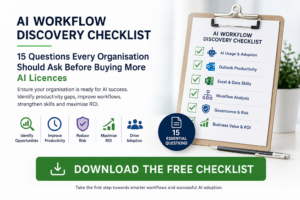
The AI Workflow Discovery Checklist – 16 Questions Every Organisation Should Ask Before Buying More AI Licences
To help organisations assess readiness, identify productivity opportunities and evaluate potential ROI, College Africa Group developed the AI Workflow Discovery Checklist.
The checklist covers five critical areas:
AI Usage & Adoption
- Are employees already using AI tools?
- Are existing licences being used effectively?
- Are employees receiving role-specific training?
Outlook, Excel & Microsoft 365 Skills
- Are employees making effective use of Outlook?
- Do employees possess the Excel skills required to validate AI outputs?
- Are Microsoft 365 tools being fully utilised?
Workflow Analysis
- Which activities consume the most time?
- Which tasks are repetitive?
- Where are the information bottlenecks?
Governance & Risk
- Have AI governance requirements been defined?
- Do employees understand validation and accountability requirements?
Business Value & ROI
- How will productivity improvements be measured?
- How will ROI be demonstrated?
AI Workflow Discovery and Measuring AI ROI
One of the biggest mistakes organisations make is failing to establish a baseline before implementation.
Before deploying AI, consider measuring:
- Time spent managing email
- Time spent preparing reports
- Time spent creating documents
- Time spent searching for information
- Time spent managing meetings and actions
After implementation, compare the results.
Successful use cases should be recorded and shared throughout the organisation.
This helps:
- Demonstrate ROI
- Reinforce adoption
- Encourage participation
- Identify additional opportunities for improvement
Without measurement, organisations may struggle to determine whether AI has delivered meaningful business value or simply introduced another technology platform.
Download the Free AI Workflow Discovery Checklist
The AI Workflow Discovery Checklist – 16 Questions Every Organisation Should Ask Before Buying More AI Licences helps organisations assess:
- AI readiness
- AI adoption
- Microsoft Copilot readiness
- Outlook productivity opportunities
- Excel capability requirements
- Workflow improvement opportunities
- Governance requirements
- Potential ROI
Many organisations focus on selecting AI tools before understanding how employees work.
AI Workflow Discovery reverses this approach by identifying opportunities, challenges, governance requirements and productivity improvements before additional technology investments are made.
Related Resources
If your organisation is evaluating AI adoption, Microsoft Copilot or ChatGPT implementation, the following resources may be useful:
- AI Strategy Consultant
- AI Consulting Services South Africa
- AI in the Workplace Training
- ChatGPT for Business Course
- Download the Free AI Workflow Discovery Checklist
For additional information on responsible AI adoption, governance and compliance:
Final Thoughts
Organisations achieving the greatest AI success are often asking a different question.
Instead of asking:
“Which AI tool should we buy?”
They ask:
“Which business problems are we trying to solve?”
Understanding workflows, improving Outlook and Excel skills, strengthening governance and measuring productivity improvements will often deliver greater value than simply purchasing additional AI licences.
AI adoption starts with understanding the work, not just the technology.
About College Africa Group
College Africa Group helps organisations identify practical AI opportunities through AI Workflow Discovery, AI Adoption Assessments, Microsoft Copilot Consulting, ChatGPT Consulting and AI Strategy Consulting.
Phone: +27 (0) 83 778 4903
Email: sales@collegeafricagroup.com
Website: www.collegeafricagroup.com

Arnold has been involved with training since 2003 and is the Managing Director and Owner of College Africa Group, a national training company in South Africa.
You may also like

Is Your Finance Team Producing Reports—or Producing Insight?
Is AI Delivering Operational or Strategic Value?
Is AI Delivering Operational or Strategic Value? During a recent workshop, a CEO asked an AI ROI question that many businesses are now starting to face: “How do we know …