AI Skills Every Employee Should Have in 2025 (South African Edition)
AI Skills Every Employee Should Have in 2025 (South African Edition)
South African organisations are rapidly rolling out tools like ChatGPT,
Microsoft Copilot and other AI assistants. Yet many employees still feel
unsure, nervous or overwhelmed when asked to “use AI” in their daily work.
HR, L&D and line managers are under pressure to turn AI from a buzzword
into real productivity and better decision-making.
For a full strategic overview of how AI is transforming South African
organisations, read our main pillar guide:
Part of the AI in the South African Workplace Productivity Series
This article is part of our national AI workplace productivity series for
South African organisations.
To explore the full framework and supporting articles, start with the pillar page:
👉 AI in the South African Workplace – Productivity Series
https://collegeafricagroup.com/ai-in-the-south-african-workplace-2025/
This article explains the essential AI skills every employee should have in 2025, with a clear focus on the South African workplace, POPIA-safe usage and HR’s role in building an AI-ready workforce. You can use it to support WSP/ATR planning, internal AI policies and your next staff training rollout.
1. Why AI Skills Matter for South African Teams
AI is no longer a future trend – it is already built into the tools your staff use every day: Outlook, Excel, Teams, Word, PowerPoint and browsers. When employees lack basic AI skills for employees, organisations experience the same pattern:
- AI tools are purchased, but adoption is low.
- A few “tech-savvy” staff use AI heavily, while others avoid it.
- Managers are unsure how to measure AI productivity or quality.
- POPIA concerns block real usage or create unnecessary fear.
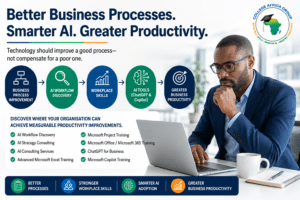
- Does AI really deliver, or is it all hype? We don’t think so, but it has a place. Let us help you.
“Do our people have the right AI skills for their jobs – and do they know how to use AI safely?”
If you’re exploring practical tools employees can use immediately, begin with Leg 1 of our series:
7 AI Tools Every Employee Should Be Using in 2025
🚀 Coming 2026:
CAG will launch a cost-effective AI for HR programme designed specifically for South African HR teams. It focuses on practical HR workflows — recruitment, onboarding, performance reviews, communication and policy writing — without the inflated pricing many providers are charging.
If your organisation wants real AI capability without unrealistic consulting fees, this programme will be a strong fit.
👉 Enquire about AI Skills Training:
https://www.collegeafricagroup.com/contact-us/
2. Core AI Skills Every Employee Needs in 2025
Below are the foundational AI skills for employees that should be included in any corporate AI training plan, regardless of role or industry.
2.1 Prompt Literacy (Asking AI the Right Questions)
Prompt literacy is the ability to ask clear, structured questions that produce useful answers. This is the single biggest difference between “playing with AI” and using AI for serious work.
Example in HR: Instead of typing “write interview questions”, an HR practitioner learns to ask: “Generate 8 behavioural interview questions for a Payroll Administrator in South Africa, focusing on attention to detail, POPIA compliance and working with tight deadlines.”
2.2 Tool Navigation and Feature Awareness
Employees must know where AI lives in the tools they already use. For example, Copilot in Outlook for drafting emails, in Word for policy drafts, and in Excel for basic analysis.
Example: An administrator learns how to use Copilot to summarise a long email thread into three action points before forwarding it to a manager.
2.3 Data Sensitivity and POPIA-Safe Behaviour
AI skills are not only technical; they are also compliance-driven. Staff must know which information they may send to AI tools, which they must never share, and which should be anonymised or summarised first.
Example: A recruiter learns to remove names, ID numbers and contact details before asking AI to improve a job advert or summarise a CV.
2.4 Workflow Design and Automation Basics
Employees should understand how to use AI to streamline everyday processes, not just single tasks. This includes creating checklists, templates and “AI-assisted workflows”.
Example: A team leader uses AI to design a weekly reporting template, then uses Copilot to populate it from meeting notes and emails.
2.5 Critical Thinking and Result Checking
AI can be confidently wrong. Staff need the habit of checking facts, cross-referencing figures and applying professional judgement to every AI-generated output.
Example: A finance clerk uses AI to draft commentary on monthly variances, but always checks numbers against the ledger before sending the final report.
2.6 Collaboration and Communication with AI in Teams
Modern teams should learn how to share prompts, standardise best practices and build small internal “AI playbooks”.
Example: HR creates a shared library of approved prompts for policies, adverts, coaching emails and performance reviews.
2.7 AI Ethics, Boundaries and Professionalism
Every employee must understand the ethical boundaries of AI use – especially around plagiarism, bias, confidentiality and decision-making.
Example: A manager understands that AI can help draft performance feedback, but may not be used as the sole decision-maker when rating employees.
3. HR’s Role in Building an AI-Ready Workforce
For HR and L&D teams, AI is both a risk and a strategic opportunity. HR is best placed to:
- Define which AI skills for employees are required at each job level.
- Update job profiles, competency frameworks and performance criteria to include AI usage.
- Design and procure role-based AI training programmes.
- Work with IT and compliance to ensure POPIA-safe AI usage.
CAG works with HR teams to turn these ideas into practical training plans, including tailored programmes for HR, admin, finance and operations staff.
4. POPIA-Safe AI Usage Guidelines (Every Employee Should Know)
Practical POPIA awareness is now a core AI skill. Your AI policy and training should help employees answer four simple questions before they paste anything into AI:
- Does this content contain personal information? (names, ID numbers, contact details, medical info, etc.)
- Is there a legitimate purpose to process this data using AI?
- Can I anonymise or summarise the data before using AI?
- Am I using an approved, company-sanctioned AI tool or environment?
These rules keep staff confident while protecting the organisation from unnecessary risk.
5. Practical Workplace Examples by Department
5.1 HR, Recruitment and Talent
- Drafting job adverts and screening questions with AI, then refining manually.
- Summarising long CVs into short, role-aligned summaries.
- Creating onboarding checklists and training plans for new hires.
5.2 Finance and Accounting Teams
- Using AI to explain variances or trends in plain business language.
- Designing checklists for month-end, audit prep and reconciliations.
- Creating first drafts of emails, policies and process documentation.
5.3 Admin, Operations and Office Support
- Summarising meeting notes into action lists.
- Drafting professional responses to common email queries.
- Building simple SOPs and “how-to” guides with AI assistance.
5.4 Customer Service, Sales and Account Management
- Drafting call summaries and follow-up emails.
- Creating call scripts and objection-handling guides.
- Generating ideas for customer education content and FAQs.
6. How to Train Employees for AI Success
One-off awareness sessions are not enough. Successful AI training follows a structured path:
- Awareness and mindset: Introduce what AI can and cannot do, with local South African examples.
- Foundational skills: Prompt literacy, POPIA-safe usage and basic tool navigation.
- Role-based scenarios: HR, finance, admin and management-specific exercises.
- Practice labs: Supervised “hands-on” time using ChatGPT or Copilot on safe, anonymised examples.
- Playbooks and templates: Capture best prompts and workflows in a shared library.
- Follow-up coaching: Review real-world use cases, refine prompts and measure value.
7. Recommended CAG Corporate Training Programmes
CAG offers practical, South African-focused AI workshops for HR, admin, finance and management teams. These programmes can be delivered onsite or virtually and can be aligned with your WSP/ATR and skills plans.
- AI Essentials for HR, Admin & Managers – 1-day practical course with HR-specific scenarios.
- AI in the Workplace – Productivity Series – focused on using AI safely in daily tasks.
- Excel Training with AI-assisted analysis modules – Excel Training
- MS Project Training – for project-driven environments – MS Project Training
- Soft Skills Training – communication, problem-solving and leadership in an AI world – Soft Skills Training
External resources such as the World Economic Forum, McKinsey and Microsoft Learn also highlight AI and digital skills as core capabilities for the modern workforce.
8. Frequently Asked Questions (FAQs)
1. What are the most important AI skills for employees in 2025?
The most important AI skills for employees include prompt literacy, basic tool navigation (ChatGPT, Copilot and other AI-enabled apps), POPIA-safe data handling, workflow design, critical thinking and a solid understanding of AI ethics and boundaries.
2. Which departments benefit most from AI skills training?
HR, finance, admin, customer service, sales and middle management benefit immediately from AI skills training. These teams handle large volumes of information, communication and routine tasks that AI can streamline.
3. How should HR include AI skills in job profiles?
HR can add AI usage under “technical competencies” or “digital skills”, specifying that employees must be able to use approved AI tools to draft content, summarise information, improve documents and support decision-making while complying with POPIA.
4. Are AI tools like ChatGPT and Copilot POPIA compliant?
POPIA compliance depends on how tools are configured and used. Organisations should work with IT and legal to approve specific AI tools and environments, and train employees to avoid sharing unnecessary personal or sensitive data.
5. How can we prevent staff from misusing AI or copying content?
Clear policies, training and supervision are key. Teach employees to treat AI as a drafting and analysis assistant, not as the final authority. Encourage them to personalise content, cite sources and always apply professional judgement.
6. How long does effective AI skills training take?
A solid introduction can be delivered in a one-day workshop, but the best results come from a blended approach: a 1-day core workshop, followed by role-based labs, practice assignments and a follow-up session a few weeks later.
7. Do all employees need the same AI training?
No. Every employee should have the same foundational AI awareness, but scenarios and depth should be tailored per role – for example, HR, finance, operations, sales and leadership each need role-relevant examples and exercises.
8. Can CAG customise AI skills training for our organisation?
Yes. CAG can customise AI skills training to your industry, policies, internal tools and risk appetite, with specific tracks for HR, admin, finance, managers and team leaders.
9. Next Step: Build an AI-Ready Workforce
If you want your staff to use AI confidently and safely, the next step is structured, role-based training. CAG designs and delivers practical AI skills for employees programmes for South African organisations of all sizes.
Talk to us about AI skills training for your HR, admin, finance and management teams:
Phone: +27 (0) 83 778 4903
Email: info@collegeafricagroup.com
Enquire online: Contact CAG
⚖️ This solution is designed to remain POPIA-appropriate when implemented correctly. It does not access, share, or store personal data. Organisations should still review their internal policies and compliance frameworks before adoption.
For corporate training enquiries contact College Africa Group – +27 (0) 83 778 4903 | collegeafricagroup.com
Download the AI Skills for Employees Overview or Request a Custom Quote
Complete the form below to receive a printable overview of this AI skills framework for employees, or to request a customised training proposal for your organisation.
Tag:AI for HR South Africa, AI in the workplace, AI readiness, AI skills for employees, AI training South Africa, ChatGPT training South Africa, Corporate training South Africa, digital skills training, employee productivity, HR AI training, HR skills development, Microsoft Copilot training, POPIA compliant AI use, workplace AI skills

You may also like
Is AI Delivering Operational or Strategic Value?

Is Your Confidential Data Safe in Free AI Tools?